Event Management – Indian Events Industry Size And Growth
Event management is emerging as a major contributor to India’s economy. It got a head start in the wake of globalization, as multinationals started pouring into India. As a profession it got created, because a need was felt to craft an event with utmost success. Initially the players in the industry were only the largescale ones with international tie-ups, helping them to organize the events. Earlier various set of activities were streamlined to create a grand event, but today elements like glamour and glitz are incorporated on a large scale into the event to give it a unique touch and make it look different from other events. Events require expertise of professionals just like any other enterprise or company. This is because different categories of events provide different products that satisfy a variety of needs. The scope of event management ranges from organizing an international mega event like the Commonwealth games to a small birthday party.
Industry Size and Growth
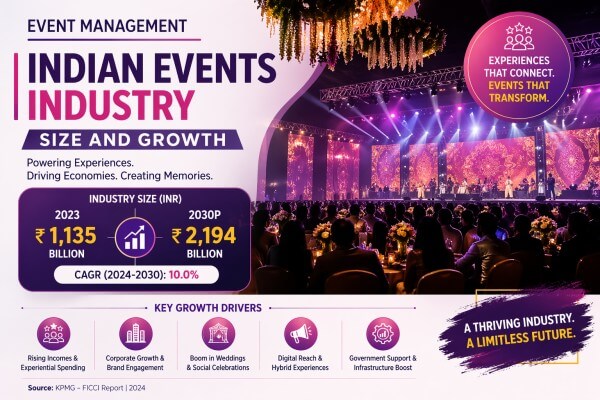
The Indian events and activation industry has great growth prospects. there are four key services in the portfolio of Indian companies. These services are Intellectual Properties (IP), Managed Events, Activations / Promotional Campaigns and Digital events. Rural, sports, digital integration and government events are emerging trends in the event industry. According to the Ernst & Young, and the Event and Entertainment Management Association (EEMA). The expected growth rate of the industry will take the size of over INR 10,000 Cr by 2021, and more in the coming years. This value represents only the revenue of ‘organized’ events and activation agencies, and not the unorganized event companies.
The marketers have shown an increasing confidence in events and activation, for their business growth. This has resulted in a consistent growth pattern in events and activation. However, there was a decrease in the revenue generated by activations from 31 per cent in 2015 to 22 per cent in 2017, showing that there is a move towards digital activations.
Event management service providers face no practical entry barriers to start operations. Unorganized players play a major role in the events and activation business. These service providers are either individuals, or small organizations who do not have defined business processes and policies.
Most of the event and activation companies have their operations mainly centered in India, with an average of 2-5 offices located mostly in the metro cities within India, to facilitate their operations. Few event companies such as Wizcraft, Percept, etc. have offices abroad. The focus of most event companies continues to be India as many feel that there are sizable business opportunities to be exploited. But the number of services being provided internationally is increasing.
Managed events and activation services are provided the most in India. The largest share of revenues come from these services. While managed events form the core of the event industry, and growth is seen in this area the most, IP events and digital events are also increasing and gaining in importance. Event management companies are starting to pay increasing importance to building and investing in IPs while simultaneously, increased below the line (BTL) marketing spends by advertisers is driving growth on managed events and activation. Because of the youth factor, there is an increased interest in delivering high quality events with a ‘wow factor’ and increased creativity.
The event and activation industry is seeing a large number of young workforces becoming a part of it and being gainfully employed. A large number of young aspirants are keen to join the industry. On the job training and development of Event Management courses can enable development of talents and professionalize the field. Till recently Event management required no formal training or education. Formal education involved the studying of advertising and public relations with a specialization in event management. The growth of the event industry has popularized studies of event management.
Event management is not a new industry and has long existed as part of the tourism and hospitality industries. In recent years, the event industry has seen a lot of changes. Events today are not positioned as a subsidiary effort towards advertising, but an independent marketing communication tool. Each category of event has its own demands that need to be addressed. This industry has generated employment of a very creative and innovative kind. It is also an outlet for people who have innovative ideas and would like to put them to practice. For example, an event management company (EMC) that works on brand building and management has to first research about the brand and its image, and the requirements of the hosts of the event. Keeping this in mind, the event is conceptualized using creative ideas and methods. Within the framework of the event, an interesting and possibly interactive medium is thought of.
The industry has grown due to the middle-income group increasingly willing to spend more on personal events such as weddings, concerts and celebrations. The event and activation activities have also received a boost from the corporate sector who see event management as an effective marketing tool. Companies like Wizcraft, Fountainhead, and Showtime have moved ahead from not just being pure event management companies, but to becoming marketing partners for their clients. The scope of the event industry is such that players are offering a complete 360-degree marketing solution to their clients right from ideation, conceptualization, promotion, marketing, arranging sponsorships and on ground execution.
The event industry is greatly driven by – growth in disposable income and consumer spending, an increase in personal events like weddings, corporate events, activation events, and an increasing need for organized events. Consumer spending helps the event industry grow. The consumer base or the clients of the event industry are corporates (both domestic and international), government and public sector, people who are increasingly spending on personal events, etc. Technology, FMCG (Fast Moving Consumer Goods), auto, media, entertainment and telecom are the largest users of the Events and Activations industry. BTL activities in marketing such as local promotions and public events meant for interaction, are greatly contributing to the event industry. Such innovative activities bring more publicity and visibility for products at the local level.
The growth of corporate sector in the wake of globalization has increased corporate events – a significant driving factor in the events and activation industry. Corporate sector relies heavily on professional event management for this. India is increasingly making MICE tourism a mode for its travel and promotional budgets. The MICE activities are yet to be taken up in totality by the corporates in India, and at present incentives form a major component of MICE. Incentive programs are receiving a boost due to exciting destinations and a combination of tradition with modern cosmopolitan touch in destinations. The demand for meetings has increased with a focus growing on details like accommodation, the traditional ‘boardroom style’ space being replaced by innovative approaches like outdoor meeting spaces and new-age technology. Airlines and travel / tour companies are targeting MICE. Destinations market MICE products to specialized agencies and the corporate world. The MICE industry can showcase latest products. Countries are promoting themselves as MICE venues to attract event managers. MICE events have become networking tools to promote successful business. The future of this industry sees growth in digital events, sports, personal events and activations as already mentioned. The government’s focus on rural development reveals increased opportunities for rural BTL / activations.
Besides corporate events, sports events are also becoming commercial events that need the help of event management services. Large scale sports events like the IPL World Cup, Commonwealth or the ICC World Cup need an entire set of event services along with their opening and closing services, during the entire course of event and use ATL (above the line) media, including digital. People today prefer celebrating events with a lot of extravagance and splendor than they did before. This includes events of a small scale such as birthday parties and anniversaries, to larger family events like weddings. All these opportunities have generated a need to make events more organized with all the logistics in place and the specialty of services that a particular type of event demands, in order to make it successful and unique. All these factors are the growth drivers of the event industry.
Strengths and Challenges
The key strength of the Indian Events industry is the ability to ‘get things done’ even in the most adverse circumstances, creativity in execution, cost optimization, and an extremely strong vendor base across cities. Delivery of high-quality events despite regulatory hurdles, poor infrastructure, inadequate talent base, large geographic spread and low-quality vendors are the clear indicators of the sheer resilience and ‘ability to manage’ nature of this industry. Ideation and creativity are key strengths where formats keep getting repeated annually, and differentiation of an event becomes key to success. Creativity as a tool needs special mention here as it is required by advertisers, it helps retain business and facilitates the growth of revenues. Delivery of good quality events despite budgetary constraints is also a clear strength. Moreover, digital integration is giving the industry a boost.
The event industry however faces several challenges. It has to be understood that events cannot be put up in a few hours, even though an event manager may work in a proper organizational structure. To organize an exclusive and customized event, requires not just working in a time-bound frame, but making specialized service arrangements, inspecting technical aspects, and working on logistics. There is lack of trained manpower and shortage of experienced personnel. Industry experts have pointed out that the talents of people / human resource entering the event industry is inadequate. The image of the industry is one reason for this as is the absence of adequate, hands-on training courses. The events industry is facing other challenges like hazy regulations around permissions for locations, GST (Goods and Services Tax), inadequate events infrastructure, transparency of costs, and varied logics used for calculating Returns on Investment (RoI). Obtaining sponsors for events also becomes a constraint many times.
Ticketed events have fared extremely poorly in India due to high taxes, and there is a need for a tax waiver / holiday for five years to give a boost to the live entertainment segment of the industry. Growth in the live events segment can lead to economic growth, increased tourism and employment generation. Due to the diversity in the types of events, there is no uniform structure for every type of event, unlike many industries which perceive themselves as a cohesive whole, for example, banking or retail. There is no one single major supply element to events, although there are some representative bodies, and some understanding that events are a major economic activity, however difficult to quantify.
Event companies mostly have a sound and profitable business model, largely de-risked through advances received from customers. Most events and activation companies pay creditors and vendors from advances of collections made from customers. Their job costing systems are in place, with the more evolved companies preparing both a pre-event profit and loss statement (or event budget) and a post-event budget-vs-actual analysis.
Any event delivers value to the client and / or to the sponsor. This value has to be measured in order to justify delivery of this value. Measurement of performance is necessary as most marketers in organizations will be able to increase spends on events if the return on their spends can be demonstrated accurately to their CEOs in a standard manner. Hence measurement of RoI in a standardized manner is very important and is a major requirement in the event and activation industry today.
Structure of Event Services
We already know that the event industry has broadened its levels of specialization, and the technical requirements have increased due to greater expectation on the part of organizers and participants. This has caused a rapid development in event related services and support organizations. Small personal events such as a birthday party or an anniversary may be a comparatively simple affair, as these events require little organizational or technical support from EMCs. On the other hand, larger activities such as exhibitions, trade fairs, VIP events, sports championships, launches, festivals and corporate hospitality activities often require a great deal of support from conception onwards. This support may be via the public sector, for example, the Ministry of Tourism and Ministry of Sports organize multiple events across the country, and these are managed by these bodies themselves. The India Trade Promotion Organization is the nodal trade promoting agency of the Government of India. Each state has its own ministries which conduct state or national level cultural and sporting events. Some educational institutions, including colleges and universities teach event management.
There are many interlinked activities in the events business besides entertainment and services, like technical and logical support that are provided by private event service providers. With an increasing complexity of needs and demands, the larger and elaborate the event becomes. Hence the standard of organization required for large scale events is very high and private services are providing a whole series of specialist activities to service these needs. These organizations typically either package services and provide the whole thing or provide one element of the service needed by an event organizer, who may wish to do the rest for themselves. The type of organizations capable of providing complete packages for events are normally:
Event Management Companies
EMCs play a significant role in providing opportunities for people who would like to enter this industry. EMCs are gaining popularity today and have basically grown out of related service or hospitality providers, which have specialized in providing the complete event. EMCs tend to be involved where the organizers have a requirement for major or VIP events, or corporate hospitality or where, for example, a product launch demands specialist design and innovation. The benefit of having an EMC is the range of expertise, ideas and experience they can draw on. For instance, in the case of a gala evening, where a dinner with a theme has to be planned, the EMC will be capable of providing the expertise for almost any theme the organizer may choose. This will include identifying a suitable menu to go with the theme, as well as full catering support in food and beverage service at the event. Development of the theme would include specialist sets, props and, if necessary, costumes for participants or guests, and all the range of support requirements from special effects and lighting to music (live or recorded) and entertainment.
An event may be unique, but the effectiveness it brings out is more important. It has to fulfil the purpose it has been set up for. Here comes the role of EMCs. For example, in designing a large-scale social event like a wedding, many challenges are faced. These include deciding the venue, preparing the guest list, incorporating client preferences, and delivering the entire wedding event within a short period of time. Right from organizing bouquets to be gifted to chief guests to dropping and picking up celebrities to and from the events, is part of the job of EMCs.
For corporate events, right from maintaining protocol to sending invites and more is taken care of by the EMCs. The scope of work for EMCs varies. They also need to make sure that they stay within the budget of the event. For example, if a fund raiser is being organized, then the efforts should be made in the direction of maximizing participation. Likewise, if a concert is being organized by an EMC, the gathering of all relevant resources must top the list of priorities. Venue, seating arrangement, accommodation, etc. has to be systematically and accurately arranged. Assigning responsibility and rightfully delegating tasks is the key feature of a good EMC.
The ascent of EMCs began with global events and shows getting organized in India. Their place was fortified after the success of a few events. The team should be equipped to handle any kind of crisis during the event to make the function memorable and successful.
Production Companies
While attempting to create a high-profile event and an event of a professional standard, the ability to develop it may be beyond the knowledge of the average organizer, delegated to do the job within a committee or other organization. Nevertheless, high profile events, VIP ceremonies, road shows, major competitions or product launches, all require specialist technical facilities and knowledge. Increasingly events of this kind are usually handled by production companies. Here, the companies are able to package the event together with the kind of wide range of technical support required. This technical support might range from set design to the training of presenters.
A production company will probably be able to undertake activities like: 1) Project management, in the case of large scale projects where the whole event is delegated by the organizer to the production company as a contractor (especially those events that might also involve building or construction sets, either of the permanent or temporary kind), 2) Design, including set and backdrop design, staging, decoration, lighting and the range of audio-visual support needed for high quality presentations, 3) Venue management, where an organization may, for example, wish to take over a unique venue, such as a huge villa, palace or stately home to use for its event, where outside expertise can be brought in (outsourcing), 4) Handling of participants or audience, which ranges from the simplest issues of ticketing and security to the full provision of VIP seat booking or allocation of accommodation or pavilion space, 5) Technical support, ranging from simple provision or hiring in of equipment to the full preparation of computer graphics, slide or video production and related facilities, and 6) Basic training of speakers, presenters and also of script writing and video production by some companies.
Though packaging for the whole event is not cheap, the production companies have the expertise and training that most organizers don’t have.
Event Catering Companies
Catering is the most important input to the events business. It has been sometimes mentioned that EMCs were earlier catering operators. Catering today is provided in three main ways: It is undertaken either in house (i.e. by an organizer or venue) or by contractors permanently employed at the venue or, alternatively, on an ad hoc basis at the venue. A venue might not be able to provide specialist catering for an event. For example, a temple ‘pooja’ gathering might have a kitchen but no caterer to run it. A larger venue may be needed nearby, or a marquee may have to be erected. These situations require catering services much before the event is organized.
Catering operators range in size and in the types of service they provide. The larger contract catering companies also run the in-house services of a number of venues and ad hoc provision for conferences, exhibition and other events including corporate hospitality. Independent caterers also have a share of the ad hoc conference business. In addition, in the price restricted part of the market such as for charitable events, there are small independent caterers who provide basic, but sound catering in the form of buffets. This type of catering for small events may be subserviced, that is the food / drink is delivered with disposable plates, etc., and the organizer simply lays it out for participants or guests to eat. Bakeries often provide this kind of subserviced buffet, simply delivered and paid for on the spot and perfectly adequate for the job. A similar service is sometimes provided by supermarket companies.
Many major hospitality or catering companies have divisions dealing with events catering, sometimes perhaps wrongly known as Outside Catering. Event catering companies range in size from small family businesses, which look after events such as local weddings or village fetes, up to major international caterers who hold contracts for significant large-scale events such as international air shows and sports tournaments, major society’ weddings, VIP dinners corporate hospitality and so on. Consider the complexity and size of the catering provision for the Commonwealth Games, Wimbledon Lawn Tennis Tournament, the Paris Air Show or the Olympics, and it can be seen that this is a very large business indeed.
An organizer may choose any one of the above packaging organizations depending on the requirements of a particular event: What are the event’s objectives? Who are the participants? How large will the event be? How complicated will the catering provision need to be? In some cases, it might even be conceivable that all three types of company are needed together, but this is not very common.
Party Planners and Professional Event Organizers
Besides major companies that are increasing in popularity, events and events related services are also provided by smaller organizations and individuals. These mostly fall under the group of party planners and professional event organizers. The first provide a range of services particularly for the personal events market, the second, for the corporate market. These would include the organization of parties, celebrations, weddings, anniversaries and many of similar events. Nowadays, though many people like to organize small events themselves, many like to hire and pay professionals to do the planning, organizing, operating and managing an event so that everything goes smoothly. Professional party planners or event organizers are obviously more used to doing this, than is the average person, who might only have to put on a batfish event occasionally, and might otherwise have to rely on friends and family to help.
Exhibition and Theatrical Contractors
Exhibition (and some theatrical) contractors have existed for many years. Their function is to provide exhibition (or backdrop) services of one kind or another ranging from design and management for large exhibition-type events to simple events. Some venues provide in house services but may rely on exhibition contractors to create and supply complete shell schemes for exhibitions. A number of exhibition contractors also have expertise in events production. However, some specialize and act as suppliers of systems, either for hire or for purchase.
Technical Services and Multimedia Support
Like catering services, technical services can also be bought in. Some venues do not have the technical support or equipment to cope with the full range of services sometimes demanded by organizers. Community halls, tents or small hotels may have no facilities apart from space and furniture. Equipment and technical support can be taken on hire from a range of companies, some of whom simply provide equipment while others provide equipment, training and technical support. Basic presentation equipment can be hired, ranging from overhead projectors to slide projectors and video players. High levels of technology, ranging from multimedia to video-walks, are now available on hire. The higher levels of technology can also be hired to provide complete presentations. Print shops are capable of coping both black and white and color material for guest packs, ticket handouts and support material such as badges or place cards and video production facilities. The range of technical facilities provided by the companies in this field is extremely wide and reflects the importance that organizers, particularly for high profile and VIP events, attach to the need for technical facilities, such as LCD projection, prompting systems (auto cues), or any other of a wide range of systems to support a stage presentation, ceremony or commentary.
Voluntary bodies, committees and individuals
Event management is one of those activities in which there is a large and active voluntary input. Many events, ranging from charity functions to village sports days, from birthday parties to local traditions, are undertaken by volunteers. This might be family or friends for a birthday or wedding, a volunteer group for a sports day or a fete. It might be a small committee set up for the purpose of running the event, anything from an annual rose growing competition to the recreation of a historic battle in full costume.
A typical voluntary committee might be made up of six or so people interested in putting on a particular event. The effectiveness of voluntary bodies is often very high due to commitment towards work and effort that the volunteers are willing to put into the activity, and also because of the lengths to which they might go to obtain resources, help, facilities and services for their event.
It is also the case that for larger or more important events, an event might be volunteer managed, through an executive committee, but the committee may employ a professional events’ organizer to plan and run the event. On the other hand, a professionally managed event might not only employ volunteers as staff but might co-ordinate the activities of a range of voluntary bodies to produce the event (such as at a carnival, where the organizers might be the city council tourism department, co-coordinating the efforts of everyone from the city band to the local majorettes).
A wide range of companies provide other services which can be hired in, contracted or purchased (depending on the service), in part or in full. This cover directly related services such as the provision of hospitality, or indirect services that exist not only to provide something for the events business, but also perform a function for the local community, for example, transport and guiding services, whose role is to get participants and audiences from the point of arrival to and sometimes around a venue. Then there are various other services such as retailing, medical support, administration, secretarial and travel. It can be seen from this approach that a matrix of distribution activities already exists in the events business. There is a range of distribution channels, like those of most industries. For example, when buying a holiday, the purchaser may go to a travel agent who might provide a whole package holiday (in the same way that an event management company can provide a whole event package). Alternatively, the purchaser might put together a holiday from various component parts, such as a flight and a hotel, having chosen the destinations using information from tourist office (equally, a client wanting an event could do it themselves by assembling the various parts, a venue, a caterer, an entertainer, and so on). The distribution channels are therefore the mechanism by which venues, markets and events activities are put together. The choice of the channel depends on the experiences and expectations of the buyer, and by the influences, that the various companies or other sellers can exert.
In India, the first mover advantage however has been with private Event Managers, as they have taken the lead.
Scope of Expansion and Careers
The event and activation industry has been undergoing expansion and is an evolving industry. Growth is expected in personal events, contests, awards, and brand launches as these are based on clients’ needs, and also because an increasing trend is being seen in the events and activation spends by marketers. Activation, MICE, field marketing and exhibitions provide sustained revenues and being at the core of the event services is expected to grow further. In future growth is also expected to be driven around:
- Sports
- Government events, as these are increasing in number, scale and outreach programs
- Digital activation, which is becoming an integral part of all B2C (Business to Consumer) activities, and Digital Integration
- Rural activation, as a result of the increased marketing spends in rural areas and towns
- Weddings, for their increasing demand
The major trends identified include sports broadcasters entering event management domain, growth of multiple sports, use of digital by sports teams, federations, athletes, leagues, broadcasters and sponsors, due to increase in access to digital mediums. Other major trends include event management courses in the offering, foreign companies entering India, events going green in their outlook, hybrid elements coming to the fore and foreign universities to collaborate with Indian universities.
Over the years, the EMCs have been able to build strong expertise in various categories. For example, the organization Fountainhead has now strengthened focus on tourism marketing with the help of FH Corporate Journeys, live music events with the help of Oranjuice Entertainment, and cultural festivals, undertaken by Fountainhead. In the last few years, the event management industry saw the establishment of Event and Entertainment Management Association (EEMA). The growth of the event and activation industry in India has the potential of attracting global players in the years to come.
Event management sees its potential in rural areas in the coming years. Event managers are looking at smaller cities, towns and rural areas, rather than holding one large event in a big city. Such events can have a larger audience at similar costs. This is expected to happen with larger EMCs taking the help of smaller event management companies in towns and rural areas, that have knowledge of rural people and rural expertise.
Many event management companies are now aiming to build their own IP portfolio. The revenues that come from IP are stable, long-standing and continue to be revenue generators for a long time in the future. The role of these companies is to create, execute and also own their own event properties. For example, Wizcraft owns and organizes the IIFA film awards, and have extended the brand ‘IIFA’ with a chain of IIFA cafes and bars that sell IIFA-branded film merchandise.
Some of the most successful and top event companies in India are – Cineyug , which is India’s premier entertainment company and the best, that covers Commercial Movie Production, Live Concerts and Arena Events, Large scale Award functions, Brand Management and Networking Events, Production of Television Software, Live TV shows etc.; E-Factor Entertainment Private Ltd focusing on Corporate and Social Event Management; Wizcraft that focuses on Entertainment and communications; Percept D Mark focusing on Entertainment, Media and Communications; DNA Entertainment Networks Pvt. Ltd that focuses on Entertainment Events; Cox and King, and SITA that focus on Travel and Event Management including Exhibitions and Conferences; and Fountainhead Trans media that focuses on advertising, entertainment and communications, to name a few. Many more are getting added to the list.
The events industry is different than many industries, where the events business is not sometimes driven by the need to make money. This business also includes personal, voluntary, charitable and philanthropic activity. Events, whether small scale or large scale enable organizations and people to participate in an enjoyable way for the mutual benefit of all concerned. They have major social benefits which are beneficial, in terms of social integration and the contribution that people can make to their community.
The market for events has expanded to the point where the need for a much better professional infrastructure for events management companies and professional event’s organizers is an indication of this demand. Hence event management holds great scope for people who are seeking jobs in the field as well as those who are keen on establishing their own companies.
There are employment prospects and specializations for those planning a career in the event industry. Apart from the position of Event Manager for which one requires education, training, and experience in other roles, many other jobs exist in the event industry. For aspirants in the event management area there are various positions in event planning, management and functional areas. These positions are: Event Director, Event Manager, Event Planner, Event Administrator, Event Coordinator, Operations and Logistics Manager , Marketing and Event Manager, Exhibition Coordinator, Entertainment Manager, Sports Manager, Venue Manager, Decor Specialist, Creative Manager, Tourism Event Coordinator / Manager, Vendor Manager, Security Coordinator / Manager, Wedding Planner, Engagement Planner, Equipment Rental Sales Manager, Catering and Food & Beverage Manager , Conference and Banqueting Manager, Pyrotechnics, or Sound and Light Consultant, Event Assistant, Administration & Sponsorship Coordinator, Light & Sound Engineer, IT (Technology) Support Manager, Arts and Cultural Development Officer, Stage Technician, Catering Director, Fundraising Event Leader, Event Designer, Costumes and Sets designer, and the list keeps expanding.
Based on any of the above positions, a job seeker builds expertise in that area related to the event after entering the industry or comes with prior expertise and individual skill set to handle the job.
In the previous years, a majority who joined the industry had lacked professional training in the field, as there were no formal or designed courses. In recent years, many institutes have started to come up with formal courses to train people in the field of event management. This has encouraged the students to aspire for a career in event management. Also known as the most profound form of advertising and marketing, event management is becoming increasingly popular as a thrilling profession. For an event manager to have expertise in any or most of the following areas would be a further added advantage: psychology, crowd behavior, consumer understanding, on-spot decision making, financial management, human resource management, marketing, safety, and logistics. Legal knowledge is also helpful, as is a solid understanding of risk issues.
Event management is no longer ad-hoc and holds many promises as a career and industry in the years to come.


