Indian Intellectual Influences – Kabir
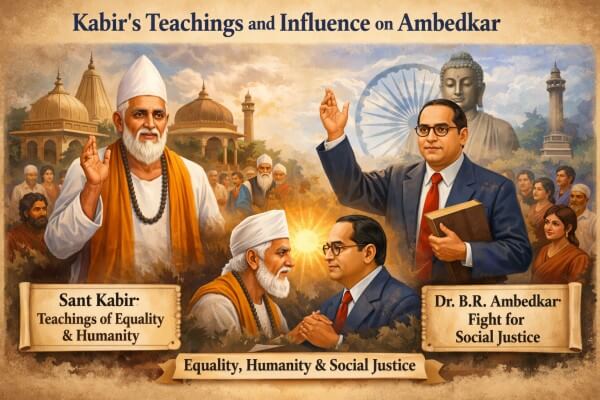
Table of Contents
Introduction
We will learn about Kabir and his ideas and teaching and influence on Ambedkar. India is a land of great poets and philosophers whose ideas contributed to understanding the true values of human life. Sant Kabir was one such illustrious thinker, great reformer and mystic poet, who urged people to recognizes human values ignoring divisions in society in the name of religion and caste. His ideas on religion and caste, particularly his emphasis on human values, left a deep impression on Dr. B. R. Ambedkar when he was a young boy. Later in his writings, Dr. Ambedkar acknowledged Kabir as one of his masters. Dr. Ambedkar devoted his life to providing equality, dignity, self-respect and justice to all socially oppressed people and in this mission of his life he greatly admired Kabir.
We will first learn about Kabir and the historical context in which he was born. Then we will talk about his ideas, particularly on religion, caste and humanism. Finally, we will explain how Ambedkar found Kabir’s teachings relevant for eradicating social evils and establishing human dignity and equality.
Life of Kabir
Many legends exist about Kabir’s life, but some facts are widely accepted. He was born in Varanasi around 1398 A.D. and grew up in a Muslim weaver family. Before we discuss his journey towards sainthood, we need to understand the times in which he lived.
Fifteenth century north India witnessed political uncertainty following the decline of the Sultanate of Delhi. Timur’s invasion of Delhi and subsequently the rule of the Lodis created political instability and lawlessness. Common people were the victims of political uncertainty. There were also tensions between the Muslim rulers and the Hindu chieftains, enmity between followers of the two dominant religious traditions was very much in existence. Attempts made to convert people, particularly those who were socially oppressed, to Islam created social tension.
This was also the period when the bhakti movement flourished in North India. Ramananda, an important proponent of the bhakti tradition, brought into Northern India the wave of bhakti tradition that had swept South India earlier.
The bhakti movement had started and flourished in South India between 7th and 12th century A.D. Rejecting ritualism and scriptural instruction, the bhakti tradition preached personal devotion to God as a means of salvation. Religion was freed from Brahmanical domination and was made accessible to common people. The gospel of humanity, equality and universal brotherhood were the major contributions of the bhakti movement. In contrast to orthodox ritualism of Brahmanical tradition and intellectualism of the Vedanta philosophy, Ramananda proclaimed the path of bhakti as the means to realize the ultimate truth. His personal god was Ram, and he asked his followers to chant ‘Ram Nam’ in order to attain salvation. Nathpanthis and the Shakta tradition also influenced the society of that period. Varanasi, being a major pilgrimage center of Brahmanical domination, was very much swayed by these changes.
This introduction to socio-cultural context of the fifteenth century North India is important to understand Kabir’s ideas. Kabir’s compositions reflect his understanding of the times he lived in and also diverse religious traditions. Kabir was the product of his time and was instrumental in bringing changes and enabling people to understand the true value of human life devoid of any form of orthodoxy.
Though Kabir in early life became a disciple of Ramananda, he remained a householder and used to earn his livelihood by weaving clothes, which was his family craft. Kabir, naturally inclined towards meditation and spiritualism, had a strong desire to become Ramananda’s disciple. It is said that Kabir being a Muslim was apprehensive that Ramananda may not accept him as his disciple. He knew Ramananda went to the river Ganges for bath and decided to lie on the steps of the bathing ghat in order to draw his attention. Ramananda stepped on him by accident and uttered in surprise ‘Ram! Ram!,’ the name of the God he worshipped. Kabir took this as his initiation as a disciple of Ramananda and in his songs, he acknowledged his indebtedness to Ramananda as his teacher.
However, as we know that Varanasi in the fifteenth century was the center of many religious traditions like Brahmanical Hinduism, Sufism, Tantrism, Bhakti movement and others and all these influenced Kabir’s spiritual ideas which are reflected in his teachings. Whatever formal training he might have received from Ramananda, Kabir is believed to have been in touch with various holy men of his time. He recognized the value of both Hindu and Muslim scriptures and contemporary religious traditions probably shaped his belief and faith in composite character. He was opposed to ritualism and orthodoxy in any form. He considered himself, ‘at once the child of Allah and of Ram’. He was not literate, but his words were meaningful and full of wisdom which even common people could understand. He did not choose the life of an ascetic but earned his living from the loom.
He married and lived with his family like a common man. But he did not hesitate to criticize orthodox ideas and expressed through songs and poems his passion for divine love. P. D. Barthwal writing about Kabir says the following:
…Kabir, who, though born of Muslim parents, had spent much of his time in the company of the Hindu Sadhus and had learnt his lessons in Vedanta at the feet of Ramananda and those in Sufism in the association of Saikh Taqi. In him [Kabir] both Vedanta and Sufism joined hands to proclaim that God is one and imageless, that he is not to be found in rituals and forms which are but veils of falsehood hiding Him from us but is to be realized as one with us being enshrined in our own hearts, and forming the substance in all that exists. And the Bitterness of the preliminary controversies apart, there was nothing in the new thought, against which the sense of a Hindu or that of a Moslem could reasonably revolt.
Kabir’s ideas invited strong reactions from orthodox groups of different religious traditions, and he was persecuted for his non-conformist ideas. It is said that representatives of Hindus and Muslims once approached the court of the Emperor Sikandar Lodi and alleged that Kabir was corrupting people through his ideas, and he claimed to possess divine power. But Sikandar Lodi was tolerant and did not punish him although Kabir was asked to leave Varanasi to maintain peace. It is said that he roamed around many cities of Northern India and breathed his last at Maghar near Gorakhpur. When he died, his followers started fighting about the last rites. The legend is that when they lifted the cloth covering his body, they found flowers instead. The Muslim followers buried their half, and the Hindu cremated their half. Whether he was Hindu or Muslim, Kabir said:
Hindu kahu tu hun nahi, musalman bhi nahi.
panch tattwa ka putala, gaibi khele mahi.
If I say I’m Hindu, I am not, and also, I am not Moslem. The body is made up of five gross elements and the Divine Being who is dwelling in it is ‘I am.’
His simplicity, use of vernacular language and everyday metaphors had major appeal among common people and soon he had a large following among various sections of society, particularly socially oppressed groups. Later on, followers of Kabir formed Kabir Panth to popularize his ideas.
Kabir’s Teachings
Teachings of Kabir were compiled by his followers. Kabir did not compose any systematic treatise, rather his work consists mostly of short verses expressed in vernacular in the form of padas, dohas, and ramainis. His dohas or simple two-line verses replete with illustrations from everyday life represent his philosophy of life. These short poems are in the Bijak, the sacred book of Kabir Panthis, the followers of Kabir. And the Bijak is one of the earliest of the major texts in modern Hindi. The compiler of Kabir’s teachings might have considered Bijakas the most suitable title for the compilation of Kabir’s verses because it refers to a document by which a hidden treasure of religious knowledge can be revealed. Kabir through his teachings tried to break the hegemony of fundamentalists in all religions and his simple words gave confidence to large number of people who were socially oppressed to stand for equality and justice.
His anguish against the divisiveness in society because of caste and creed is very much visible. He taught that humanity is above all religions and God is the father of all. Therefore, he asked people not to fight with each other because they were all brothers. For Kabir, neither does Hari exist in the east nor Allah in the west. They are one and reside inside the human heart. Kabir advised everyone to seek truth within their own hearts. Living with his family and earning through his loom, he advocated dignity of labor and preached that simple life and complete devotion to God is the way for realization of the absolute truth of life. Evelyn Underhill, in his introduction to the translation of One Hundred Poems of Kabir by Rabindranath Tagore, the great poet, writes in the following words about Kabir’s religious philosophy.
The “simple union” with Divine Reality which he perpetually extolled, as alike the duty and the joy of every soul, was independent both of ritual and of bodily austerities; the God whom he proclaimed was “neither in Kaaba nor in Kailash”. Those who sought Him needed not to go far; for he awaited discovery everywhere, more accessible to “the washerwoman and the carpenter” than to the self-righteous holy man. Therefore, the whole apparatus of piety, Hindu and Moslem alike the temple and mosque, idol and holy water, scriptures and priests were denounced by this inconveniently clear-sighted poet as mere substitutes for reality…
(One Hundred Poems of Kabir. Translated by Rabindranath Tagore. Delhi, 1985, pp. 5-6).
Kabir primarily preached religion of love without any distinction of caste and creed. He was an enlightened saint who suggested that True God resides within a righteous person. He denounced caste system and idolatry. From this discussion, we find that the core of Kabir’s religious philosophy was his firm belief in humanism. Here I would like to quote some of his verses from his Bijak which will further explain his teachings.
Saints, I see the world is mad.
If I tell the truth they rush to beat me,
if I lie they trust me.
I’ve seen the pious Hindus, rule-followers,
early morning bath-takers-killing
souls, they worship rocks.
They know nothing.
I’ve seen plenty of Muslim teachers, holy men
reading their holy books
and teaching their pupils techniques.
They know just as much.
And posturing yogis, hypocrites,
hearts crammed with pride,
praying to brass, to stones, reeling
with pride in their pilgrimage,
fixing their caps and their prayer-beads,
painting their brow-marks and arm-marks,
braying their hymns and their couplets,
reeling. They never heard of soul.
(Hess and Singh. 2015:.42).
Brother, where did your two gods come from?
Tell me, who made you mad?
Ram, Allah, Keshav, Karim, Hari, Hazratso
many names.
so many ornaments, all one gold,
it has no double nature.
(Hess and Singh. 2015:.50-51).
There is nothing but water at the holy bathing
Places; and I know that they are useless,
For I have bathed in them.
The images are all lifeless, they cannot speak;
I know, for I have cried aloud to them.
The Purana and the Koran are mere words;
Lifting up the curtain, I have seen.
Kabir gives utterance to the words of experience;
And he knows very well that all other
things are untrue.
(Tagore 2005: 50-51).
Pandit, look in your heart for knowledge.
Tell me where untouchability
came from, since you believe in it.
Mix red juice, white juice and aira
body bakes in a body.
As soon as the eight lotuses
are ready, it comes
into the world. Then what’s
Untouchable?
Eighty-four hundred thousand vessels
decay into dust, while the potter
keeps slapping clay
on the wheel, and with a touch
cuts each one off.
We eat by touching, we wash
By touching, from a touch
The world was born.
So who’s untouched? Asks Kabir.
Only he
Who has no taint of Maya.
(Hess and Singh. 2015:.42- 55).
Who’s Brahmin? Who’s Shudra?
Brahma rajas, Shiva tamas, Vishnu sattva…
Kabir says plunge into Ram!
There: no Hindu. No Turk.’
(Hess and Singh 2015:.67)
Reading the above poems you definitely get the impression that Kabir was ahead of his times. One can see the voice of protest and dissent to the existing socio-religious practices in Kabir. Kabir the mystic was essentially a reformer and at the same time a symbol of social revolt. People later on started worshipping Kabir as a god although Kabir himself was against idolatry. In Kabir’s philosophy, the emphasis was on humanity and universal brotherhood.
Kabir’s Influence on Ambedkar
Ambedkar’s father, Ramji Sakpal, was a follower of Kabir and in Ambedkar’s household, devotional songs of Kabir were sung every day. Ambedkar grew up as a child listening to these devotional songs and witnessing the belief of elders in the bhakti tradition. This had a lasting influence on Ambedkar’s life. As he started experiencing social discrimination at school because of his birth in a Dalit family, Ambedkar felt the need to raise his voice for social equality and human dignity. In this journey Kabir’s teachings shaped his ideas.
Kabir was one of the three masters who contributed towards shaping his life. He admitted that as a young boy he was greatly influenced by Kabir as his father was a devotee of Kabir. He believed that it was Kabir who truly grasped the essence of Buddha whom Ambedkar considered his first and best master. Though Kabir lived in and around Varanasi, his ideas spread to different parts of India. The fifth Sikh Guru, Guru Arjan Dev, had incorporated many verses of Kabir into the Sikh scripture, Guru Granth Sahib.
After Kabir’s death his followers compiled his teachings and spread his ideas. His ideas had strong appeal particularly among the socially oppressed people. Temples were built and singing of Kabir’s verses became part of people’s life. Far away from North India, in the family of Ambedkar, Kabir had a special place. Ambedkar’s parents encouraged him in childhood to recite Kabir’s poems. In Ambedkar’s writings on contemporary socio-religious practices one can find the reference to Kabir’s spirit. Arguing on the need for abolition of caste, Ambedkar wrote:
There have been many who have worked in the cause of the abolition of Caste and Untouchability. Of those, who can be mentioned, Ramanuja, Kabir and others stand out prominently. Can you appeal to the acts of these reformers and exhort the Hindus to follow them? Reason and morality are the two most powerful weapons in the armory of a reformer. To deprive him of the use of these weapons is to disable him for action. How are you going to break up Caste, if people are not free to consider whether it accords with reason? How are you going to break up Caste, if people are not free to consider whether it accords with morality?
(Vasant Moon 1989: 74).
One can find the reflection of Kabir’s ideas on religion and social division in the name of caste and creed in Ambedkar’s struggle against the caste system and various prejudices practiced in the name of Hinduism. The ultimate goal of these two great historical figures was a religion of humanity above anything else. Both advocated abolition of caste and untouchability. Ambedkar was not against religion, but he was against the misconception and misrepresentation in the name of religion.
He said,
…you must give a new doctrinal basis to your Religion – a basis that will be in consonance with Liberty, Equality and Fraternity, in short, with Democracy. I am no authority on the subject. But I am told that for such religious principles as will be in consonance with Liberty, Equality and Fraternity it may not be necessary for you to borrow from foreign sources and that you could draw for such principles on the Upanishads.
(Vasant Moon 1989: 77-78).


