Introduction and Scope of Events
Introduction
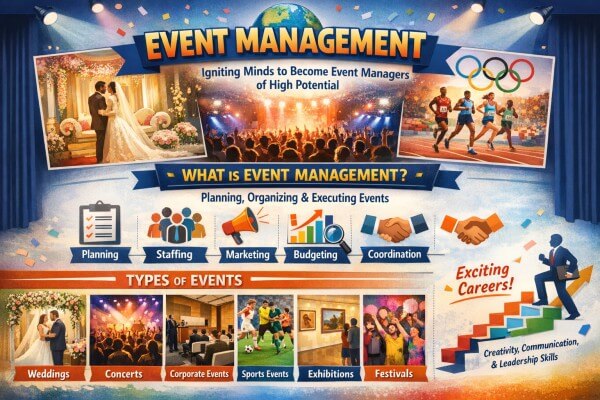
We come across events in our daily lives either as observers or participants, but very few of us have managed events. The aim of this program is to ignite the minds of learners to become event managers of high potential. Event management is a process involving planning, organizing, staffing, leading and evaluation of activities for an event. The recent growth of festivals and events as an industry around the world means that management can no longer be ad hoc. For example, the elaborate weddings happening all across the world are not a one-day effort, but a result of many months of thinking, diligent brainstorming, planning, evolving creative concepts and generating a celebration event – the wedding. A number of companies are hosting and organizing events on a regular basis. These events are either small-scale private events or large-scale international events.
There is a huge range of events starting from big, internationally organized sports such as Commonwealth Games or Olympics to the family naming ceremony of the newborn baby next door. Event management is offering exciting career prospects in the form of concerts, music launches, weddings, theme parties, private parties, felicitation functions, product launches, exhibitions, fashion shows, community launches, trade shows, birthday parties, corporate events, etc. With the growing willingness of people to spend more on such events and with the commercialization of event management it has emerged as a career option for the new generation, the youth. Public or private, commercial or charitable, celebratory or commemorative – events bring people together to share an experience and to produce the desired outcome.
A large number of aspiring individuals have already entered the field because they see a huge market potential as far as demand and supply is concerned. Besides this, there are event management companies that take on consultants, who work with them on a freelance basis, as and when the need arises. Creativity is the most profitable aspect of the event management profession. Here the basic task is to plan and present an event, where ‘out of the box’ thinking is applied. Besides this, other required skills are good communication and planning, marketing, budgeting, negotiation, client management, and leadership skills. One must further have immense patience and insight to see the smallest details of the event management process and always stay focused on the event goals. The other skills required for an event manager are good networking skills, good listening skills, business analytics, time management capabilities, ability to take on challenges, problem-solving skills and adjusting to rapidly changing situations.
Historical Perspective of Events
The history of events can be traced to the history of mankind. As long as mankind has existed and lived in groups of families, and in communities, events have been taking place. Human society used to look up to traditional celebrations, in the form of ceremonies and rituals to get a break from the tedium of daily life. Events were also held to highlight some important activity or a person. In earlier times, large scale events were conducted by ordinary people. In rural settings, the celebrations of religious and folk festivals have been taking place. We still get a chance to see carnivals, festivals and fairs in different places at various times in the year. Some major events revolve around periods like Christmas or Easter of the Christian calendar, ‘Dussehra’ and ‘Vinayak Chaturti’ of the Hindu calendar, and ‘Eid-ul-Zuha’ and ‘Milad-un-Nabi’ of the Islamic calendar, through the celebration of festivals based on these times. Similarly other festivals associated with the coming of seasons, like harvest and spring seasons in India such as ‘Makar Sankranti’ and ‘Basant Panchmi’, are also celebrated. We have events that are celebrations associated with a nation’s significance, such as Independence Day, Republic Day and so on.
Both in private and public, people feel the need to mark the important occasions of their lives, to celebrate the key moments. Some events leave a significant impact in people’s lives. Events like the Olympics and the New Millennium, help to mark eras and become significant milestones by which people measure their private lives. For instance, being ‘born at the dawn of the new millennium’ or she got her ‘first job before the Commonwealth Games,’ and so on. Historically, the organization of small local events was relatively uncomplicated and needed no extensive managerial expertise. The organization of a wedding, for example, could be done, most often, by the bride’s mother with help from the two families involved and the vicar, priest, religious or other official representation. (In past times, especially up until the Victorian period, ‘expert’ advice often came in the form of a dancing Master, employed to give the wedding festivities some formality of style. There were also quite specific local rituals to be observed, which acted as ‘checklists’ for the activities). Some weddings are still done this way and are within the ability of non-specialist people to organize and run.
Large-scale event management is not particularly a recent development. If we look at history, the Roman gladiatorial games had a variety of contests, activities and theatrically mounted sea battles, and a large crowd that flooded the arenas. The scale and complexity of such games shows that it would have required a professional event management organization to run them in today’s world.
History tells us that there have been specialists of various kinds to organize events (right from temple priests for the Greek Games to the Lord Chamberlain’s department for Queen Elizabeth). The coronation of a king or queen was a grand, but highly complex event. The military was called to organize state events. This involved great ceremonies, and the army officers were often seconded to do the organization of such events. This is still being followed as in the case with modern state ceremonies like parades, state visits, pageants and festivals. The organization of historic ceremonial events was done through military organizational skills.
New traditions were formed alongside the old because of the cultural collision between Aboriginal people and the first Europeans. The ancient Olympic Games were first held in 776 BC and were restarted in modern times in 1896. The Olympic Games, first held in 776 BC at Olympia in Greece, had the purpose of celebrating the festival of Zeus, the most important Greek God. The history of the event’s industry in Australia is interesting. In Australia, probably the first ‘event’ which took place after the arrival of the First Fleet was a bush party to celebrate the coming on shore of women convicts in 1788. After World War II, festivals with floral names became prominent such as Ballart’s Begonia Festival and Toowoomba’s Carnival of Flowers, to name a few. New events emerged in the 1970s due to rise of multiculturalism, paving way towards community arts movement and a new range of festivals. In 1980s and 1990s a pattern for the contemporary events industry was established.
The Commonwealth Games in Brisbane, Australia, in 1982 brought in a new breed of sporting events. The Commonwealth Games also initiated a career in ceremonies and celebrations for an ABC rock show producer, Ric Birch, which led to his taking a key role in the closing ceremonies at the Los Angeles and Barcelona Olympics. Later in the Olympic Games of Los Angeles in 1984 it was proved that major events could be economically viable. Here a combination of Hollywood-style spectacular, with a sporting event in a manner which had not been done before was attempted to set a standard for all similar events in future. The production and marketing skills of the television industry brought the Olympics to an audience wider than ever before. The entrepreneurs who were involved in the 1980s economic boom of Australia got a learning from this and the America’s Cup defense in Perth and Fermantile in 1986-87 were held, attracting major economic and tourism benefits to Western Australia. By 1988, there was an increase in special events, and this was matched by governments setting up State events corporations, thus providing public sector support to special events.
Organizational events have also left lasting legacies. These may be anything from a political party conference to a motor show. After the industrial revolution, many countries began to celebrate and display their industrial achievements, through a number of industrial and commercial exhibitions in many major cities, that often developed out of local trade fairs in towns and cities around medieval Europe. Fairs are popular events, being held through centuries for displaying products, goods and other wares. One of the first great international industrial fairs was the Great Exhibition in London of 1851, besides the one held in Paris in 1849. The London exhibition was organized in the Crystal Palace; a special hall and 13,000 exhibitors had participated from all over the world. During the Victorian period, fairs were held in London, Amsterdam and Paris especially, where a series of fairs from 1855 to 1900 were held. The Paris Exposition of 1889, that was the idea of the then French Prime Minister Jules Ferry to demonstrate France’s industrial, commercial and engineering might, left behind the world-famous legacy, the Eiffel Tower.
Pushkar Mela, the biggest attended fair in India, is an example of one of the biggest organized fairs since ancient times. Originated on religious lines, such melas (fairs) have been a meeting ground for big and small traders, along with traditional games and entertainment. Ancient events such as Indian fairs and festivals with their visually spectacular depiction of epic themes interwoven with singing and dancing were a means of expression of the spiritual and cultural tradition of a community.
‘The Times of India’ celebrated 150 years during 1988-89 in a grand manner and this was one of the major turning points in the life of events in India. The functions that were organized were in-house activities to promote their products, i.e. magazines to increase circulation and help people to recall their paper. The celebrations were termed as an ‘event’ as very rarely they had been organized on such a large scale. During the celebrations, several events were held for the first time. Significant among these were ‘The Raagas,’ a three-day classical music and dance festival featuring Zakir Hussain, Birju Maharaj and many well-known figures. The Timeless Art Event displayed works of Anjali Ela Menon, M.F. Hussain and Manjit Bawa at the platforms 1 and 2 of the historical Victoria Terminus (VT) Station which was converted into an art gallery for ten days. Eminent personalities in Victorian tongas, handcarts and vintage cars were taken from the J.J. School of Arts to VT. The late J.R.D. Tata was amongst the esteemed guests. During the celebrations the international auction house Sotheby’s auctioned their painting on the training ship ‘Jawahar’, the proceeds of which went to charity. Timeless Art and Yves St Laurent branded T-shirts, caps, pens, postcards and ceramics were distributed in thousands. The 150th birthday of the prestigious Old Lady of Bori Bunder was celebrated by posting police, army and navy bands playing at bandstands all over Mumbai. It was a landmark event for the TOI who managed the events with their own in-house team. No event management expert existed in those days. Since then, entertainment and infotainment programs have been termed ‘events. Today’s largest and best event management company (EMC) in India – Cineyug, was also born then.
Events become memorable due to their scale, uniqueness and frequency of occurrence. Some of such events become annual properties or Intellectual properties (IPs) for their hosts, corporate houses / sponsors. Over the years event properties that became popular are the LIC Zee Cine Awards, Coca Cola World Cup, Smirnoff Fashion Awards, Kingfisher Derby, Hero Honda Indian Television Academy Awards, Dabur Vatika Star Screen Awards, Lakme Fashion Week, IPL (Indian Premier League) and the Filmfare Awards, to name a few. ‘One-off events,’ that serve objectives for the limited duration they last, such as Bryan Adams concert, Roger Waters, Elton John Nite, A.R.Rahman ‘Live’ in concert become popular, but over a period of time, they become a part of history. Sporting events like the IPL, Olympics and Commonwealth games are much awaited events and become memorable ones. Many events today become awaited calendar happenings. The third Thursday of March every year is the most awaited day for the Indian and international film industry when the Oscar Awards ceremony is held.
Today events are happening on a mammoth scale. To quantify, in monetary terms, how much events are worth, as an industry is a challenge as the requirement of events is increasing. Events in this new millennium will be catering to all demographic segments of the population. They have come a long way in terms of categorization and specialization. Today, attempts are being made to reach out to rural India through events, by corporate for their communication campaigns.
Event Management – The Concept
Event management is the application of the management practice of project management for the creation and development of festivals, fairs, weddings, exhibitions, competitive events, sports, television shows, product launches, meetings and conferences. According to Shone and Parry event management can be thought of as an art, rather than a science. The event process involves studying the needs of the client, identifying the target audience, devising the event concept, planning logistics and coordinating the technical aspects before executing the event. There has been a massive growth of the event industry around the world, suggesting that it has a positive future.
Definition of Events
Events have been defined in various ways. This section presents some of the definitions. Silvers defines event as an experience, carefully crafted to deliver an impact on the person in attendance. Basrur defines event as an occasion where a gathering of a target audience meets to celebrate or experience an occurrence, designed and organized to communicate and interact with a purpose to achieve an objective. It is a dynamic plan involving a live multimedia package, organized with a preconceived concept or idea. According to Singh, events are an organized business. Event management is a process of organizing an activity, social or professional, for a particular target audience.
Kotler defines events as occurrences designed to communicate particular messages to target audiences. In this context, Gaur and Saggere talk about events from a marketing perspective. Events have been understood as an effective marketing tool. Here events are an additional media whereby two-way (or active) communication is possible. Event is something noteworthy which happens according to a set plan involving networking of a multimedia package, thereby achieving the clients’ objectives and justifying their need for associating with events.
A comprehensive definition given by Gaur and Saggere is as follows: An event is a live-multimedia package carried out with a preconceived concept, customized or modified to achieve the client’s objectives of reaching out and suitably influencing the sharply defined, specially gathered target audience by providing a complete sensual experience and an avenue for two-way interaction. From this definition it is evident that an event is a package so organized as to provide, reach and live interaction between the target audience and the client to achieve the desired impact. The population of the target audience that the event is exposed to is called the ‘reach’ for the event. The live interaction process facilitates communication between the clients and the audience. This process strengthens the possibilities of mutually beneficial transactions occurring in tune with the desired objectives for the event. Events have therefore been termed as ‘Experiential Marketing.’
There are specific rituals, presentations, performances or celebrations that are consciously planned and created to mark special occasions. Such events help in achieving particular social, cultural or corporate goals or objectives. McDonnell, Allen and Toole describe these events as ‘special events.’ Special events can include national days and celebrations, important civic occasions, unique cultural performances, major sporting fixtures, corporate functions, trade promotions and product launches. Special events, according to them, have become a growing industry. The field of special events is now so vast that it is impossible to provide a definition that includes all varieties and shades of events. Goldblatt has defined special events as a unique moment in time celebrated with ceremony and ritual to satisfy specific needs.
Getz has provided two definitions of special event, one from the point of view of the event organizer, and the other from the customer’s or guest’s point of view:
- A special event is a one-time or infrequently occurring event outside normal programs or activities of the sponsoring or organizing body.
- To the customer or guest, a special event is an opportunity for a leisure, social or cultural experience outside the normal range of choices or beyond everyday experience.
Key Elements of Events
Gaur and Saggere have explained that events have six key elements, namely event infrastructure, target audience, clients, event organizers, venue and the media.
- Event infrastructure is a broad term that encompasses the core concept, people, talent and structure.
- Target audience is the people who have the ultimate experience of the event and for whom the event organizer consciously designs the event.
- Client from the event organizers’ viewpoint is the sponsor or financier of an event venture.
- Event organizers design and execute all activities concerning an event.
- The media is the vehicle used to communicate details of the event to the target audience
- Venue is the place where the event takes place.
Let us understand the roles of two very important elements in event management: (i) target audience / customers / consumers, and (ii) clients. The target audience is the group of people who ultimately experience the event and for whom the event manager consciously designs the event. Event design depends upon the demographic profile and the number of the target audience. The first step in event designing involves target audience, as you will read in the next sub-section, designing the event experience. Clients are the people or organizations who act as sponsors for any event and approach the event management companies for organizing their event. They sponsor the events because they use events as an effective marketing communication tool, in order to create for themselves a desired position in the minds of the target audience.
Event infrastructure includes those essential elements without which there cannot be any event. These essential elements are core concept, core people, core talent, and core structure. The nature of this infrastructure varies with the event types / categories and variations within a particular type of event.
The core concept of the event is related to the type / category it falls under. ‘Core concept’ is concerned with the fundamental underlying ethos / meaning of the event and how it came into existence. ‘Core people’ are people who capture the attention of the audience through their performance or acting on center stage, playing the role of host on or off stage. Core people influence the audience to create a desired impact in terms of a favorable position for the clients’ brand in the audience’s mind. ‘Core talent’ is the expertise and skills of core people and this is important for every event type. Core talents like reputation, charisma and knowledge of the performer or host, attract and influence the audience. For example, in a music concert, the audience that gets attracted to the event depends on the talent of the performer. Further, whether the event is a classical music concert or a pop music concert, depends on the type of instrument and the music being played. Similarly in sports, every game is specialized and has limitations in terms of number of participants etc. Different talents of players are required in playing each game. Core talent is game specific, i.e. talent required in cricket differs from talent required to play basketball.
In a formal and structured event there is a proper organizational structure, in which roles and responsibilities are clearly assigned to different members of the organization along with proper delegation of authority to carry out these roles. When an organization manages a particular event type / category, it becomes specialized and therefore lucrative from its marketing point of view. This organization for efficient management is denoted as the ‘Core structure.’ Core structure is established for the purpose of efficient management of an event. Competitive events like sporting events are the most organized and structured both nationally and internationally.
Event “Product”
Often in event management literature, you will come across the term ‘event product.’ Additionally, Robinson et al., added event experience as a part of the actual event product. It is used to denote the market offering of an event. It includes the concepts of production and consumption within the event. Events are produced and consumed simultaneously. Event product according to Brassington and Pettitt, Robinson et al., McCabe, and Tersine and Hummingbird, can be understood as (i) Core event product – which means the actual need or want of the consumer that the event is fulfilling, (ii) Actual event product – which denotes the event format and content in totality, and is also called tangible product, (iii) Augmented event product – this means all the extras that are offered to the event consumers for delivering the event experience, and (iv) Potential event product – means opportunities for further developing the event in future, either by redefining the event concept or further supplementing the current concept with additional features.
Designing the Event Experience
According to Silvers, the professional event coordinator uses a sequential process to consistently produce events of any type. This process helps to deliver the intended event experience through the following steps:
- Conduct the necessary research to determine expectations and create a customer profile / target audience who attend the event.
- Conceptualize the event, assessing the scope of the event required to meet expectations.
- Determine which event elements and components will provide the features of the desired experience.
- Visualize how all these event components will and must fit together and design the strategy for implementation.
- Select the best products and providers available and affordable.
- Finally monitor the delivery of the experience.
The job of an event manager involves visualizing concepts, planning, budgeting, organizing and executing events such as fashion shows, musical concerts, corporate meetings and seminars, conferences, exhibitions, wedding celebrations, theme parties, product launching etc.
An event is thus an experience, carefully crafted to deliver an impact on the people attending it. The best event experience is the one where the event design is formed with the activities, the environment surrounding the event and various multi-sensory effects (music, decoration, performances, videos etc.), in such a manner that the intended impact is delivered effectively to the people in attendance. You have to remember that an event is based upon a particular need. People do not buy an airline ticket because they need an airline ticket. What they need is to be in Mumbai on Wednesday or in Amsterdam on Friday. Thus, the event manager must remember that s/he is not just taking an order but crafting a solution to what the client truly needs.
For a basic understanding to meet the needs and expectations of those attending the event, the following course of action has to be adopted:
Understanding Expectations
To produce an event, you have to gather some basic information first – who, what, where, when and most importantly ‘why’ from the client.
Some clients for whom the event has to be conducted may be very open and specific regarding what they want to achieve from the event, others may not be able to articulate well at this juncture.
The event manager has to find out what type of event it is – a product launch, fund-raiser, wedding party, musical evening or any other? When and where is the event to be held? Where have the guests’ attended events in the past and their profile? What type of event experience will satisfy their preferences? Why is the event being held?
The event manager or event coordinator needs to have a clear understanding about the purpose of the event. Goals and objectives of the event are very important. The goal or objective may be to celebrate success, commemoration, matrimony, anniversary, festival celebrations, appreciate culture or art, increase sales or increase awareness. The entire experience that is generated through the event must have value.
Even a family reunion, anniversary, birthday party or local wedding may have measurable objectives – having specific people over, enjoyment and entertainment levels of guests, or having an event that is more lavish than a colleague or rival. The event manager has to develop an evaluation strategy from the very beginning, that will increase the chances for event’s success.
Develop the Concept
The event manager has to conceptualize the final event. An overall picture of the final event, that is the concept, must be put together and be managed with the logistical, operational parameters and practices into the event plan. Event managers thus are quoted by Alvin Toffler as ‘Experiential Engineers.’ It can be done by starting with the concept, developing the theme or event name and then filling in all the details like the roots branching from a tree base, or by beginning with the event elements, and building a pyramid with all the details until a complete picture of the event emerges.
Creating the Event Experience
Any person who aspires to take up the event management profession has to learn how to create the ‘event experience.’ The event experience may be a civic celebration or a charity fund-raiser, an anniversary or a wedding, a corporate product introduction or incentive program, a sports event or a convention event. It may be a company picnic, a hospitality reception, a grand opening or a family reunion.
To create the desired event, experience the right event elements and components will have to be identified as these enhance the experience. For this the event manager will have to visualize the experience, from start to finish from guests’ point of view. The event manager has to identify those elements that helped in the success of the previous event, elements that will take advantage of opportunities and strengths. After studying the guests’ needs, wants, expectations, then arranging the elements and adding layers of detail, the desired event experience is created. Every event experience should be designed to incorporate the six critical dimensions of an experience which are – anticipation, arrival, atmosphere, appetite, activity and amenities. These are interdependent on each other.
The Demand and Scope of Events
Historically, the demand for events has been determined largely by social factors. These factors were the need for social integration, interaction between individuals and communities, the need for public celebration, promoting community cohesiveness, group activities, social norms and social structure. Religious, civic, trade and community rituals, and ceremonies also lead to the demand for such events.
These historical determinants still hold true in the modern societies, where despite technological innovations, events are driven primarily by social needs. But events today also address economic, organizational, political, marketing, philanthropic, fundraising and charitable needs.
Many of us must have had the experience of organizing small birthday parties, anniversaries and similar such events. Today these events are no more just family affair, rather are extended affairs, and mostly organized by event managers as their expertise is required. Events such as concerts, fund-raisers, product launches, conferences, exhibitions, entertainment events, festivals and fairs, and sports championships need a great degree of involvement by experts from outside. Big events like these are managed as projects by EMCs.
The emergence of EMCs and the coming into prominence of the field – Event Management, as a separate industry, also indicates the increasing demand for event activities. This has led to a felt need for professionalizing the field. The creation of events is also due to economic factors, an increasing standard of living, urbanization, changing demographics, exposure to media and increasing literacy rates. Much as in the European Union, India in the wake of globalization and liberalization is seeing the growth of the event industry as a contributor to the Indian economy through events ranging from small scale private events to large scale international ones. Be it hospitality, tourism, business, entertainment, festive, social and cultural events, the demand for events continue. Same is true for commercial events where the demand has led to an increase in trade fairs, conferences, exhibitions, product launches etc.
Events are also driven by motivations. For example, the primary motive for holding an athletic competition may be to provide an opportunity for local athletes, to display their abilities, and the secondary motives may be to provide an opportunity for people having same interests to interact with each other.
Getz underlines the motivational aspect for participating in events, which might be physical, social or personal, and also organizational. The primary need for attending a Nokia cellular phone launch may have nothing to do with personal needs, but everything to do with your organization that sent you there for organizational purpose.
People therefore participate or attend events based on several motives, not just one. These could be fulfillment of personal expectations; for competition/ achievement; to make or break a record; for educational, tourism, entertainment or recreational support for other participants in the event and so on. Ticketed events are an activity where the ability and willingness to pay the price becomes an issue, and the secondary cost implications in terms of transport, travel costs, time, distance and effort, or some other personal priority like looking after children at home becomes an issue.
Although an event may be a single activity (such as a wedding) with one homogeneous group of people attending (one market segment), certain types of events comprise a range of activities that are attended by different groups or segments of people, with different motives of being there.
Shone and Parry quote four kinds of potential demands for events – ‘Current demand’ (that demand which our event satisfies at the moment), ‘Future demand’ ( that demand which our event could satisfy in the future, over a normal growth period), ‘Latent demand’ ( that demand which is sleeping until you provide an event for it), and ‘Suppressed demand’ (that demand which exists for our event, but cannot get to it due to being suppressed by price, time, availability, lack of disposable income or other reasons). A new event might tap a demand that is latent or suppressed in some way.
The scope of an event can be understood in terms of its market demand. An event organizer has to first find out about the demand for an event, because without this knowledge, it is impossible to provide what the target market wants. Different events that are held in a city or town will attract different target groups. Those who attend the annual ‘dastkar mela’ (artisans’ fair) might not be the same people who attend the annual painting exhibition. Over time, some events become popular than the others, some may be new while some may be not, all these depending on reasons like costs, extent of popularity or shortage of volunteer expertise. The planning and execution of an event not just depends on the market demand, but also on the availability and kind of expertise, funding and support.
Many times, the objective is to create a new market and then expand on it. In this context, the scope of an event expands for the event organizer. For instance, it can be seen that there are further potential and less exploited demand for North- East Indian Dance Festival or a tribal dance festival, and by organizing this event repeatedly, it becomes successful and grows over years. A successful example is the North Sea Jazz Festival, which began in 1975 with less than 300 musicians, few venues and visitors. The level of demand at that time was small, but over the years the number of visitors and musicians increased to 1,50,000 and 1,200 respectively. One could not have foreseen the level of demand to visit and participate in the event 25 years ago, because in those days, jazz was a latent demand. It is possible that jazz might have further potential and unexploited demand, which is not being tapped for a variety of reasons. This happens for many events.
The event market today is very diverse, is changing and cannot be seen as a homogeneous whole. It is difficult to quantify a particular type of event in a particular town, city or state. This is because the range of events activity is from small personal events to large scale events. And within each type of event there are variations. Information and data collected on any type of event will enable event managers to estimate the size and scope of that event. In order to understand the market demand of events, one should first analyze a particular event in terms of the given time, effort and the cooperation of the organizers. Once this is done, the market for the event can be analyzed too, in terms of what kind of people are likely to attend or have attended in the past, their motives of going to the event and the benefits of their attending or participating in the event.
To understand how events can be planned and marketed and how market information should be recorded, continuous monitoring and recording has to be done in the following areas – visitor numbers, visitor spending, visitor activity and participation, advertising effectiveness, and visitor satisfaction. There are a number of events for which the potential market will be just an estimate. But for some events, the potential market is known and fixed, as in the case of weddings, birthdays and anniversaries. Then there are events that, while retaining their uniqueness, recur at intervals, such as annually or biannually, and in this case, market is relatively well known from previous experience. For example, if 50,00,000 people came to the International Book Fair last year, it is very likely that 50,00,000 people will come this year. Some events become perishable. A one-day event, for example, an open-air musical concert or a one-day hockey match, may either be very exciting or may suffer from an unexpected weather condition, traffic or a clash with another similar event equally exciting.
The unique feature of events is that they break through the clutter of thousands of commercial communications or advertisements that consumers encounter every day. Events bring in customized and innovative, firsthand experiences and reinforce the brand image of the product or service. As critical marketing tools for direct communication, events have started featuring as large parts of a marketing budget for any organization, and feature equally alongside advertising spends and internet marketing. Apart from creating brand awareness, events allow an independent platform for the product to be uniquely showcased, and registers in the audience’s mind instantly. Many brands get rejuvenated or re-launched at various stages of their product life cycle through innovative events to gain back their market shares. Events also provide a critical ‘touch and feel’ experience to the consumer through interactive mode. Events enable the implementation of marketing plans of many companies which include a) Test marketing, b) Focused sales to a captive audience, c) Increasing customer attendance in stores, and enabling sales promotions, and d) Enabling relationship building and PR activities.
Marketing research also gains significantly by events as they help in market database collection, updating of data on a regular frequency and creation of consumer panels. Events usually provide instant and accurate feedback on products and services. Over and above the marketing aspect, the economic benefits to the region holding the event are significant. Large scale events tend to give a facelift to the resources and infrastructure of a place and generate positive employment. For example, the Commonwealth Games changed the face of Delhi’s National Capital Region territory in terms of roads, bus and metro services and infrastructure.
The demand for event managers is growing exponentially with corporate, cultural and personal occasions needing professionals to manage them. Opportunities for people who want to enter the industry are expanding. One of the most profitable aspects of the field of event management is the need for creativity, which provides a major opportunity for earning. Events such as theme parties, birthday celebrations, anniversaries and other family celebrations have become glitzy events today as people are focusing on themes, décor, colors, interiors, buffet spreads, foods and beverages, and celebrity appearances. These are handled by a team in event management and offer enormous scope. This also reflects the ability and willingness of the consumer to spend for events.
The Indian events industry today broadly has the following types of services, namely intellectual properties (IPs), managed events, activations and digital events. These include MICE events (Meetings, Incentives, Conferences, Exhibitions), sporting events, rural events, field marketing, contests, awards, brand launches, personal events including weddings, events seen by a large audience at one time with the help of internet etc. The number of business opportunities offers great career prospects for the youth. Managed events, i.e. corporate events or personal events provide the largest revenues to the event business and hence the enormous scope. The demand for events has grown to such an extent that print and radio companies have started activation services, which are event activities of small size that help to promote or sell a product / service, in some cities across India. Thus, event management encompasses a range of profiles that offer opportunities in different areas.