Building Portfolios
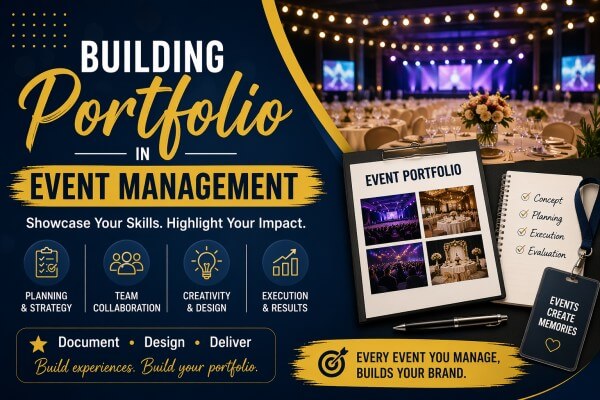
We will learn how presentations and portfolios are used to effectively communicate our abilities, talents, services and achievements to our potential clients. People in the field of event management are increasingly using portfolios to portray their work or their organization. This tool, if used effectively, will help sell services better and help build the reputation of the business entrepreneur or the company.
Preparing Presentation for Effective Communication
Event managers or senior team members use presentations as tools to convey ideas, event briefs, event plans, event designs, plans for event safety / security / logistics and several needed aspects of the event when communicating with their teams and external stakeholders. Basically, a presentation can be used while talking to a group or in briefing and debriefing meetings and may usually contain a ‘persuasive’ element. Presentation requires skills as the presenter controls the presentation and the message is not just delivered verbally, but augmented by facial expressions, voice projections, body language, gestures and visual aids, videos etc. Presentations are delivered directly before the audience and sometimes done through videoconferencing when the presenter is present at a distance. Presentations are of different types according to their purpose. However, we will now learn some basic steps in preparing presentations.
Basic Steps in Preparing a Presentation
Consider a situation where you have to delegate duties to your team for the forthcoming event and you decide to use a presentation for the same. We will call this presentation as PAeg and read it as an example. Following would be the steps:
Step 1. Decide the objectives of the presentation: The main objective of your presentation PAeg will be ‘to delegate the collective and individual duties (invitations, ushering, escorting the guests, venue preparation etc.) to all the volunteers for a music concert.
Step 2. Make a plan: To prepare presentation PAeg, you need to plan the following:
Formulate objectives: There would be at least one objective for every task. The objectives of PAeg may be to a) make all volunteers aware of the venue and traffic movement for the day of the event, b) delegate individual duties to the volunteers to escort each guest personally from car to the concert ground / auditorium, c) look at the seating arrangement, mikes etc. by a team of four volunteers, and so on. You may think of more objectives and add to this list.
Identify your audience: Audience comprises the receivers for whom the presentation will be done. They need to correctly understand the information we want to pass on. In this case, all the volunteers who report to you- their team leader, would be the audience. If it is felt that some other personnel should also be made aware of these details, you may include them in this list.
The beginning should be catchy to get the attention of audience: You can establish a theme or a catchy title to introduce your PAeg, so that your audience feels interested and energized.
Collect information to be conveyed: The details of your presentation should now be ready with you. This will consist of information such as what you expect from the event, traffic movement plan, details of the program design, safety and security arrangements, food and refreshment arrangements, escorting arrangements, transportation etc. We also need to have the list of volunteers, their contact numbers and other details, all the duties which need to be delegated, the names of the volunteer heads, venue details and details of the delegates of the conference. Additional information can be added according to the specific needs.
Arrange messages in a sequence: The messages have to be arranged in a proper sequence. For example, first show the list of volunteers, followed by the team they belong to, name of the volunteer head of each team, team leaders, their duties etc. You may use flow charts, venn diagrams, thematic diagrams and diagrams of the event site for this purpose.
Break down your topics into subtopics and smaller parts: Now we will show the breakup of all tasks assigned to each team and will write down all details.
Support message with visuals, data or statistics: Most of the presenters prepare slides that are loaded with heavy content and lengthy sentences. The audience tends to lose interest and focus, in such presentations. Preferably present your messages in the form of points and not heavy sentences. You can elaborate and explain each point while moving through your presentation. Substantiate your presentation with tabulated or listed information, venue photographs and other pictures to clarify and compare your information. Graphics will add more interest and enhance the quality of your presentation. Care should be taken that the presentation is not very long and does not exceed the time limit.
Step 3. Prepare the slides: The number of your slides may vary depending upon the content, but they would follow the following sequence:
- Title slide
- Table of contents
- Message slides
- Conclusion
- Thank you
Step 4. Add value to the slides: You can add more value to your slides, make them eye catching and appealing by using appropriate background, different colors, animations legible font, outlines etc.
Step 5. Prepare your talk: You will now prepare your talk in accordance with the slides you have prepared and by explaining the content given in each slide.
Step 6. Make the Presentation: While making presentation you have to keep the following points in mind and begin your presentation:
- Introduce yourself and greet the audience.
- Present the structure of the presentation to the audience so that they know what to expect.
- Create a rapport with your audience by maintaining eye contact with them and using heuristics.
- Present the information given in the slides by explaining each slide. Your communication skills, PR and public speaking skills will be put to use at this stage.
- You can repeat important points again and again to make sure that the message has been correctly understood.
- You may pause and invite questions during the presentation if there is a necessity.
- You will end the presentation by summarizing your objectives and by thanking everyone present in the room for their cooperation.
Step 7. Invite questions and feedback: A question answer session is important to clear all doubts of the audience and to answer their queries. A good presenter will see to it that all the information has been communicated for necessary action during the event. A senior presenter or an experienced presenter may use heuristics to give solutions to problems / questions posed in the question answer session by the team present. Through her / his experienced based examples, such discussions will enable the group to understand messages better and make them aware that taking necessary actions through quick decision-making is necessary in certain situations. Feedback also completes the communication cycle i.e. message sent by sender to receiver and receiver has given the feedback to the sender.
Step 8. Schedule a follow up date: If needed, you can schedule another date / meeting as a follow up for this session before dispersing. This is also required if another agenda related to the presentation has to be discussed in the next presentation.
Planning and Building Portfolios
Portfolio is a type of specialized presentation prepared to showcase your talents, originality, creativity and skill sets to potential clients, often to convince them. It can be used as business card or as a brochure (manual or electronic) or as an album to introduce your organization to potential clients to highlight your achievements by briefly highlighting your client list, major events successfully executed in the past.
Origin of Portfolio
The word portfolio has been derived from the French word ‘porte folio’ meaning a page carrier or a device to carry loose pages. Portfolio can be defined as collection of pictures, actual photographs, drawings, paintings, architectural sketches, collage or designs emphasizing the creativity, originality, talents and skill sets of a person, an organization or an event. It can be in handmade, printed or digital forms.
As the event industry grew, many event managers felt the need for a tool to introduce themselves and effectively communicate their talents as well as achievements to their potential clients. They needed to convince stakeholders and new clients, to gain their confidence and attract business. This led to the development of portfolios as an important communication tool.
Today, event managers use portfolios to introduce themselves, their organization or any event by showcasing the talents and achievements. They are the most important tools for promoting an event firm. Creative event managers portray their abilities and skill sets through portfolios. The portfolios used today are largely digital, sent through e-mail or created on the specialized computer software and printed on paper. The portfolio used on the event company’s website is sometimes in the form of a showreel.
Purpose of Portfolios
An event portfolio or a showreel showcases your work to draw in more customers and clientele by providing examples of your work. Owners of Event Management Companies (EMCs) are business owners or entrepreneurs who offer services to people. By showing examples of their work done, they will prove to the clients that they can work for the clients in a satisfactory and reliable manner. The portfolio will show the quality of the EMCs work. Each portfolio has a goal or a purpose. The purpose of the portfolio helps in choosing our content, visuals and presentation. A portfolio can be prepared for the following purposes:
- To establish the EMCs entity
- To introduce the products and services offered
- To build their brand value in the market
- To generate business from potential clients and stakeholders
- To gain the confidence and faith of clients in the EMCs abilities and talents
- To highlight their achievements
- To present a potential event idea to a client
These purposes help an event manager to select suitable information and organize the portfolio in an appropriate manner to reach the goals.
Advantages of Portfolios
Portfolios can be used to your advantage as an event manager. The advantages of using portfolios are:
- To showcase your work done successfully in past like some major events.
- To highlight your client list and how your events have helped them in achieving their goals; for example, a good product launch contributes significantly to promotion of the product.
- To signify the evolution of your organization from its birth to the successful position it enjoys today in the industry.
- To showcase your creativity, originality and skill sets.
- To create suitable impression on the potential client and to gain more business.
- To enable client to bid for the event.
- To share the event design or event components with the client.
- To highlight the positive aspects of your work like beautiful venues and layout, extensive security arrangements and heart-warming welcome of the guests.
- To market your products and services.
- To create your brand value.
However, to reap all these advantages an event manager requires different portfolios for each purpose.
Types of Portfolios
Portfolios can be of different types depending upon whom the EMC or the individual entrepreneur wishes to get introduced to with the goal/s. Individual portfolios are basically of the following nature:
Individual Portfolios
- Self-introductory / profile (like business card)
- Job seeking
- Self-campaign
- Individual work achievement / showcasing
Company / Institution / Organization Portfolio
- Profile of the Company / Institution / Organization
- Showcasing the work achievements, client list or promoters / reputation building
- Showcasing skill set, innovation, creativity or originality of work and ideas
- Marketing or product selling / sales generation
- Networking
An EMC or a business entrepreneur may have one or many of these portfolios. We should select and use a combination of these portfolios, depending on our purpose.
Building Portfolio – Steps
You can follow some basic steps and try to build your first portfolio. You can also look at the profile portfolio given as a case study later in this article to get some more ideas regarding visuals, content and their presentation.
1- Decide the purpose or goal: The first step in preparing portfolio is to clearly define your purpose or goal. Each portfolio has a specific goal. You should have clear understanding of what you wish to achieve by preparing and showing this portfolio. The type of event you organize helps you to determine your target market. For example, you may decide to prepare your own profile to introduce your organization to your potential clients.
2- Define your target market: You also need to define your target market or the people who require your services. They may be the clientele you wish to attract to your business in case you have started on your own. Develop the contents of your portfolio based on the needs of your clientele. For example, if you are a wedding planner, your target market is families within a certain financial demographic. If you are a corporate event organizer who focuses on brand activation, your target is companies, and so on. Therefore, consider all those features in your portfolio that are meant for your target market and appeals to them. Your target market may be of a varied range, depending on the number of markets you cater to. For example, Fountainhead is one of the top experiential marketing agencies of India that caters to activation events, MICE and digital events. Similarly, E-Factor Entertainment is a popular EMC that provides services for wedding planning, corporate event management, brand promotions and entertainment. The different services that each of these organizations provide are for different target markets. An EMC may therefore have one type of target market or more than one type as in the above cases. While developing a portfolio consider all the factors that may evoke the interest of the target market in starting business relationship with us.
3- Select the appropriate content: The next step is to select the content of the portfolio. You need to decide what type of content is required and be selective. A look at the case study given later in this article will give an idea about what kind of content is there in the portfolio. However, you would decide the content of your portfolio according to your own goal and audience. For this purpose, you need to follow the following steps:
Select appropriate technology
As portfolios are mostly created on computer and are also often sent through email on internet, PDF, jpeg or other similar file formats can be used to create a digital portfolio. Customers can be provided an online portfolio of your work. You can take the help of some specialized software or of companies that prepare portfolios. However, keep the technology simple. PDF versions of the documents are on the website, that are easy to remember, find and type. The best file format is the one which can allow us to show our visuals and written content with clarity.
Design Cover Page
The cover page introduces the portfolio to the client and hence should be able to generate interest instantly. It should be attractive with very little written matter. The background should be such that the name or title should stand out and get focus.
Insert Information (recent and updated)
Include information that you wish to convey to your client. Organize this information page wise with appropriate titles. You can also use the knowledge you have gained in preparing presentations to select and organize your content as portfolio. However, the information used in the portfolio should be recent and updated.
Reinforcement on the goal
The selected content must reinforce your goal. Study the latest developments in your field of event management and other EMCs before preparing your portfolio. The entire content should help in focusing on the purpose of preparing portfolio. Your portfolio should be able to communicate your message to the client very clearly and precisely.
4- Insert content that has received recognition: Choose the best images / visuals. These should reveal the best of your work, your achievements. Portfolios of many successful event companies do this. On the other hand, if an EMC handles educational events and wants to highlight events conducted for publishers, or writers with writing abilities, it should choose the best examples of those abilities. The written matter should be supplemented with appropriate visuals. In either of the cases choose visuals or written documents that have received most recognition, appreciation like awards and best feedback from customers.
To create interest, some focal points through catchy pictures, visuals, different background, symbols or statements such as inspirational lines could be introduced. If you are creating a self-portfolio for event planning, these will help reinforce your goals. You may even put up your education certificates be it from a diploma / graduate / post-graduate program of a university or institute. This will help the potential clients to understand that you are serious about education and your business.
5- Add case studies or recent glimpses of events: Case studies of specific events, or event glimpses add interest to the portfolio. At the same time, it is one of the best ways to showcase your skills.
6- Review and edit: Portfolio should be reviewed and edited to ensure that it is appropriate for the purpose it is designed. Editing also helps in making the portfolio precise, and informative at the same time.
7- Present by printing or as computer file: As discussed already your portfolio may take the form of a website or an online portfolio, or a file that can be sent to the client by email. You may depict details of your business, highlighting your best work in a brochure or even a scrapbook. It is preferable that the portfolio is bound and put together like an album with large images, and the portrayal of the best work product of your company. This is very useful when meeting your potential client.
The Principles of Portfolios Design
We need to create a winning portfolio so that we can sell our services with ease and confidence. Though there are various possibilities for developing the contents of a portfolio as discussed above, the basic design and development process is the same. The principles of effective portfolio design are guidelines to help us improve our portfolio and will safeguard us against pitfalls.
Define the criteria and strategies for success: A project that is well planned, becomes a factor for success. Hence it would be appropriate to define our criteria for a successful portfolio even before we start preparing it and the way it will contribute to our goal.
Prepare and use multiple portfolios: We may have more than one goal which we wish to achieve. An EMC may have different departments (each having different skills) that offer services to cater to different clientele / target markets. One portfolio cannot help in achieving all goals. Hence sometimes it is better to prepare different specialized portfolios. In many EMCs it becomes a necessity. A profile portfolio will be different from an event overview portfolio.
Target the market: Our portfolio must target specific market and specific audience to motivate our potential clients or to create a right impression on our visitor.
Usability of portfolio is top priority: The portfolio must be usable and easy to navigate. For this purpose, we must use simple but right technology rather than the most advanced one. If our potential clients are unable to open and look at our portfolio on their computer, then the entire purpose of using a portfolio is defeated.
Use the right technology: We are preparing a portfolio to achieve our goal and not to promote certain technology or to test someone else’s technical skills. Therefore, use simple and easy to use technology.
Plan the portfolio like a project: We must build a portfolio as if we have taken up a project. Plan it, organize it, prepare it and update it regularly.
Narrow down and select the work / skills to be promoted: As mentioned earlier, our portfolio must project our best works, and specific skill sets we wish to promote. Therefore, rather than showing many of us works, we should select one or few of our best skills and project them appropriately. Include extra information that makes you stand out from other EMCs or businessmen, such as outstanding events, awards, thank you letters, feedback from previous clients, and facts and figures about your business that make you impressive.
Depict clear information: The information should be clear, and it should not have too many colors, prints or lines. The text should be easy to read, preferably in block letters and a flowing format that can make the client or observer to follow easily. Contact information should be easy to find and easy to use. It must be prominently placed in the portfolio.
Give a personal touch: Though portfolios help us in showcasing our professionalism, a personal touch helps to build its own identity.
Promote the work though networking: We can promote our work by joining online communities where many clients can view our portfolio. Blogs, websites, professional networking sites may be used for this purpose.
Develop long term portfolio goals: Since a portfolio is used for a long time, we need to update it periodically to achieve our long-term goals.


