Indian Intellectual Influences – Jyotiba Phule
Introduction
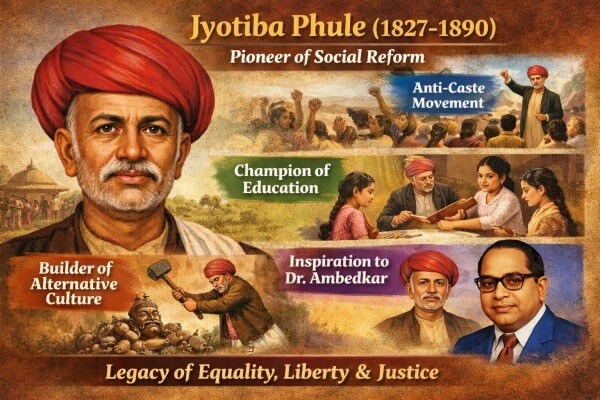
We will introduce about Jyotiba Phule contribution as social reformer, anti-caste movements, education and influence on Ambedkar. Jyotiba Phule (1827-1890) was an exemplary social reformer and revolutionary thinker of modern Maharashtra. He, by rooting himself in the anti-caste tradition of India, had initiated a formidable movement against caste system and religious tyranny which Gail Omvedt has described as ‘cultural revolt of modern Maharashtra’. His ideology and activism represented the spirit of modernism where values like humanism, rationalism, individualism and scientific temper were cherished. Many emancipatory movements espousing human rights had begun under his ideology and leadership.
By establishing Satyshodhak Samaj, he inculcated a spirit of anti-caste radicalism among the Shudr atishudra masses. He raised the issue of exploitation and oppression of peasants and organized peasant movements in Maharashtra. His efforts to spread awareness among the industrial working class and had given rise to the first working class union in Mumbai. He challenged Brahmanical cultural hegemony and initiated the struggle for alternative culture.
Social Reformer Jyotiba Phule
Let us discuss social reforms done by Phule. In the nineteenth century, ideas of social reform were engrossing every sphere of society including religion, society, economy and politics. Social reformers who wanted reforms to take place in all these fields acknowledged religious reforms as the precondition for all reforms. They inaugurated religious reform movements based on rationalism, individualism and humanism. In the social sphere, they introduced women’s reforms abolishing inhuman, irrational practices and customs; in the economic sphere, they sought to change capitalist industrialization and emphasized the importance of the propagation of western physical sciences and in the political sphere they sought a change espousing the values of democracy, republicanism and secularism.
The early social reformers emerged from the upper strata of society. Their conception of social reform revolved around issues related to family; they wrote and spoke against irrational customs like sati and ban on widow remarriage and argued in favor of women’s education. However, they never could muster the courage to act as they preached. Moreover, they never protested against caste and untouchability (Ambedkar, 2013: 219). In contrast, Phule with his piercing critique of social and religious institutions and committed activism brought about a radical turn in the milieu of social reforms.
When other social reformers were advocating reforms in consonance with religious scriptures, he was criticizing them as a caucus of few interested elites. When reformers were giving merely lip-service to the cause of women’s education, he started a school for girls. When due to ban on widow remarriage, young widows were falling prey to illicit relations and were committing infanticide, Phule started an asylum for them and their children (Keer, 1973: 98-101). He opened his well for the untouchables and demolished proscriptions based on the principle of purity-pollution (Phule, 1980: 145-46).
He derided the Vedic myth of the origin of varna as unscientific and irrational and rejected the Brahmanical theory of divine origin of caste. Moreover, his logic for rejecting varna/caste hierarchy was drawn from the first century Buddhist text called Vajrasuchi. The crux of his argument against caste was based on the Buddhist tenet that ‘as there are different species in the animal world there are no such a difference in human world’ (Bagade, 2010:71).
There were several arguments defending hierarchy of caste and he demolished each of them. The argument for ‘occupational division of caste’ held that caste inequality was convenient and useful. Phule countered this by questioning, ‘if Brahmin’s three sons are taking up three different occupations, will they be of three different castes? If a Brahmin woman as a part of her daily chore is removing the excreta of a child, will she be treated as untouchable’ (Phule, 1980:336)?
He refuted the hereditary basis of caste by demonstrating that the sons of great kings, emperors and artists never possessed the same qualities and achievements as their parents (Phule, 1980:218). By drawing attention to the immoral conduct of Brahmins, he disputed the logic of caste hierarchy based on purity-pollution which considered Brahmins pure and untouchables impure (Phule, 1980:314-16).
The most meticulous part of his critique of caste was unravelling of the exploitation and oppression of the caste system. He not only brought out the material aspects of caste exploitation but also pointed out the social and cultural relationships of domination and subordination of caste which formed basis of material exploitation. By uncovering the exploitation techniques employed by Brahmin priests and moneylenders, he initiated a struggle against caste and untouchability.
Phule offered a scathing critique of patriarchy. He unraveled the complex processes of women’s subjugation. According to him ‘men’s tendency of aggression, want oneness and deceit was responsible for the genesis of women’s slavery.’ He stated that ‘to subjugate women men had used violence and had implanted their selfish and distorted renderings of women in the religious scriptures. He notes that women were enslaved through hegemonic discourse of negative constructions in three ways:
- Depicting women’s nature (Stri-Swabhav) as weak, cruel, evil etc.
- Portraying women’s behavior (Stri-Charit) as scheming and adulterous
- Projecting women’s ethical conduct (Stri-Dharm) as pativratas or loyal, dedicated and servile wives.
Against such kind of male positioned narrative and against the entrenched patriarchal domination, Phule applauded women’s motherly attributes (like sacrifice, dedication, hard work, and kindness) and contended that ‘women are superior to men’ (Phule, 1991:345).
The inequality between men and women was characteristic of Hindu religion. Patriarchal order entrusted responsibility of Pativratadharm on women but exonerated men from such a responsibility. It allowed Brahmin men to marry as many times they wished but prohibited Brahmin widows from remarrying. Phule condemned all kinds of practices and customs that supported men-women inequality. By putting a poignant question that ‘there are several instances of wives in grief of deceased husband had committed sati but could anybody cite a single example of a man who in sorrow of deceased wife has ever committed sati’ (Phule, 1980:359)? He was as if on a mission to constantly expose the inequality and injustices inflicted on women.
Phule had also revealed the linkages between caste and gender. He juxtaposed everyday labor of Shudra women with everyday activities of Brahmin women (Phule, 1980:584- 586). This comparison certainly cautions us to be wary of using women as a single category. Women were exploited in different ways under caste-gender hierarchy. He pointed out that under the purity-pollution scale of the caste system, Brahmin or high caste women were exempted from productive labor and the drudgery of labor was always inflicted on low-caste women.
He offered scathing attack on Brahmanical religion. He rejected divinity of Vedas and commented that ‘if Vedas would be made public, little girls would destroy its credibility’ (Phule, 1980:398). By employing scientific and moral logic, he criticized myths and their divine heroes and by demonstrating irrationality and exposing exploitation he denounced religious rituals. He condemned religious scriptures for inflicting inequality and injustice on the Shudra-atishudras and women. He exposed the cunning, crafty and exploitative nature of priestcraft. And he rejected all the illusory notions of traditional religion such as rebirth, karmsidhant, heaven and hell as the concoctions of scheming priests (Bagade, 2006:330).
- Abolish the slavery of the Shudra-atishudra masses
- Make them aware of their human rights
- Undertake their improvement (O’Hanlon, 1985:231-32)
Satyshodhak Samaj espoused the principle of monotheism, rejected mediation (of the priest) between creator and devotee, opposed idolatry and advocated philanthropic activism. It launched a vitriolic attack on Brahmanical hegemony, rejected all kinds of irrational, inhuman faiths, customs and traditions. It propagated universal ethics based on equality, liberty and fraternity and provided an alternative scheme of rituals.
Educator Mahatma Phule
Phule began the project of emancipatory education by establishing institutions namely ‘Native Female School’ which started a school for girls in 1848 and ‘The Society for Promoting Education of Mangs and Mahars’ which started a school for untouchables in 1851. As there was no female teacher available, Phule trained his wife Savitribai, who became the first female teacher of India. Both faced several adversities including paucity of funds and government apathy and violent opposition put up by orthodoxy. Fighting against all odds, Phule and his wife Savitribai ran several schools and worked relentlessly in the field of education.
Phule honestly believed that social change can occur through education. For him, ‘the defining character of human being is to possess intelligence and knowledge’ (Phule, 1980:256). He attacked the traditional policy of prohibition of education to the strishudr-atishudra. According to him denial of access to education made the subaltern castes ignorant. And due to this state of enforced ignorance, these castes could not realize the injustice and slavery inflicted on them; nor could they recognize their human rights. He identified that the caste-based inequality of power/knowledge is upholding caste and avowedly suggested universal education as the important panacea. He believed that as universal education brought revolution in Europe, it will bring revolution in India too (Phule 1991:229-244).
Phule criticized colonial apathy towards mass education and complained that the state policy of allocating larger share of funds to higher education resulted in the neglect of primary education (Phule, 1991: 243). He accused the government of ignoring the education of lower classes by toeing the trickle-down theory. The government was under the illusion that the higher classes would spread education among the lower classes. The government squandered the taxes it collected from poor famers on educating the upper classes. But children of the rich, who availed free education and achieved material success on its basis, did nothing to assist the uplift of the underprivileged. The British policy ensured ‘monopoly of education by the Brahmins’ and, as a result, ‘all the senior government posts are monopolized by them’.
Due to poverty and ignorance, the subaltern castes were not ready to understand the importance of education. The Shudra-atishudras, under the spell of religion, perceived education as sin. They were so much under the sway of religious gullibility that they dreaded to send their children to school. Phule urged the British government to initiate the spread of primary education. Phule submitted several constructive suggestions to the Hunter Commission:
- Each boy or girl up to age 12 should be given compulsory and free primary education.
- The government should spend half the amount of the local funds on primary education.
- The number of primary schools should be increased.
- Provincial governments should allocate enough funds for primary education.
- Municipalities should take responsibility of the expenses on primary education.
- The education department should control primary schools (Phule, 1980:167-182).
He wanted the British government to spend people’s money collected through taxes on developing an infrastructure for universal education. He repeatedly asked, advised and warned the government in this regard (Mani, 2005:273). Criticizing colonial education for not serving the immediate interests of caste subalterns, he pointed out that neither did it offer them technical and professional capabilities to better their lives nor did it prove to be instrumental in freeing themselves from the shackles of Brahmanism. He suggested radical revamping in the approach, content and pedagogy of colonial education setting alternative path of education.
Phule offered devastating critique of Brahmanical pedagogy and stated how it made the subaltern lose the track of reality. Both, Brahmanical and colonial pedagogies, never intended at cultivating a critical bend of mind in the students. Their descriptive and memory-based pedagogy neither could give the students capability to pose questions nor could impart skills or creativity to solve them. Their pedagogic stance was so alien and textual that it detested any connection with everyday lives of the downtrodden students. It remained abhorrent towards imparting occupational or technical skills. It was so commanding that it never respected students’ ability of thinking and treated them merely as passive objects.
Phule initiated a new kind of pedagogy which aimed at nurturing rational thinking among students. He rejected teacher-student relationship prescribing command to teacher and obedience to students. He encouraged inquisitiveness and spirit of inquiry among students. He introduced problem-posing dialogic pedagogy which brought teacher and students on the same level of active engagement. This pedagogic technique of placing questions and finding solutions made students critical thinkers. It not only enabled students to approach the reality in a critical and creative way but also encouraged them to take up struggles to transform the reality.
Phule’s pedagogy is evident in his writings. Some of his texts such as Gulamagiri and Sarvajanik Sataydharma use dialogic mode in which the narrative runs as dialogue between students and teacher Jyotiba. Unlike colonial education where teacher is adult and student is child (Krishna Kumar, 1989), Phule places both teacher and students on an equal footing; both pose questions to each other, procure facts, offer analysis, verify statements and derive their own truths. His pedagogy helped caste-subaltern students in building critique of existing knowledge and making fresh inroads in the field of knowledge.
The structure of education under the British government was entirely text-oriented and did not provide practical or skill-oriented technical education. It also was not imparting the knowledge of Western physical sciences. And the preponderance of Brahmin teachers added an instrument of pedagogy which was memory-based, uncritical and bookish. Colonial education was not that useful to meet the needs of the laboring subaltern-castes. Therefore, Phule vehemently criticized these limitations of colonial education (Phule, 1991: 723-25) and asserted in favor of professional and technical education. He advised that the knowledge of subjects like physics, astronomy and chemistry should be given at primary level. According to him, education should address the lifeworld of the toiling Shudra-atishudra masses and should enrich their skills and capabilities to make advances in the industrial and agriculture field (Phule, 1991: 714-26).
Both the traditional Brahmanical and the colonial education had shown apathy towards physical labor. Phule criticized this policy of delinking physical labor from intellect. For him intellect and physical labor were inseparable. He attacked the tendency of stigmatizing labor and urged that schools should be associated with industries so as to impart professional and technical education. Thereby, students can learn to tackle the predicament of practical life and turn themselves into independent and thinking individuals (Narke, 1998: 20).
He observed that the anti-labor vanity of the Brahmanical intellectuals was a major hurdle in the development of education. He was in favor of an education of ‘doing’. He placed the subjugated knowledge of the caste-subaltern central to his scheme of education. Colonial education laid emphasis on liberal literary knowledge which was most suited to the perpetuation of Brahmin hegemony. On the one hand, it stripped caste subaltern from their advantage of knowing and doing of indigenous science and technology and on the other hand it bolstered the already dominant position of Brahmins through text and memory-centered education. Phule wanted to set a balance between education of doing and education of concepts or abstractions. Illiteracy had denied the opportunity of conceptual training to the caste-subaltern and led them to stagnation. Therefore, he actively argued in favor of an education that would impart conceptual training and develop critical and analytical capabilities. He wanted the education of ‘doing’ as enshrined in the everyday knowledge of the caste-subaltern to be blended with abstract training of European physical sciences and technology (Phule, 1991: 714-26).
Builder of Alternative Culture
Religion had remained a dominant ideology in India. It operated as the key institutional force upholding customs, traditions and law codes. It, as an ideological and cultural apparatus, had provided basis to the institution of caste, untouchability and patriarchy. Phule realized that without the critique of religion and without an alternative scheme of religion and culture, social reforms neither could be inaugurated nor could be cherished. Therefore, Phule started an alternative religion called Sarvjanik Satydharm.
He set out on a quest for religious alternative in the trajectory of anti-caste traditions of India. Phule invoked the following traditions, which according to him had combated with the regime of religious slavery, caste oppression and Brahmanical hegemony:
- The rationalist tradition of Buddha
- The materialist tradition of Brahaspati
- The medieval bhakti tradition of saint Tukaram
He grounded his alternative on Deist rationalism which by espousing universal religion has propounded universal ethics based on liberty, equality and fraternity. He built his alternative by dwelling on counter-cultural lineage of Shudra-atishudra masses of Maharashtra. By invoking indigenous deities like Khandoba Bhairoba as historical heroes and ethical role models, he put them in the alternative scheme of rituals.
A major concern of his alternative religion was to build universal ethics which, he argued, could be realized through undertaking the criterion of self-examination i.e. atmparikshan (Phule, 1980:458). The individual in the processes of self-reflection undertakes a critical inquiry of her or his own experiences of social relations, where her or his personal experience of social treatment of inequality, slavery, exploitation and humiliation becomes unacceptable and, therefore, ethically unwarranted. The rigorous process of self-reflection creates, justifies and legitimizes moral basis of society, cherishing values such as liberty, equality, fraternity, industriousness, and philanthropy. (Bagade, 2006:334).
He presented Indian history as a series of conflicts between Aryans and non-Aryans. He declared that till now the history of India was history of Brahmin domination. He traced the process of subjugation of non-Aryans. He constructed the utopia of Bali’s kingdom. Liberty, equality and fraternity prevailed in his kingdom; patriotism, democracy, republicanism were integral to his polity; his efficient and pro people officers like Khandoba Kalbhairi were zealously serving people. During Bali’s regime, art and knowledge prospered; people lived a happy life. He argued that the history of India since fall of Bali has been a history of caste struggle (Phule, 1991: 150-153). Thus, by cherishing the utopia of non-Brahmin past, he recovered the insurgent caste subaltern subject position rooted in anti-caste tradition.
He confronted the colonial and the nationalist portrayal of a monolithic Hindu past by retrieving anti caste struggles of the Samkhy philosophy, Lokayats and Buddhist religion in ancient India. By narrating a continuous trajectory of ongoing anti-caste struggle, he rejected the colonial periodization of Indian history. By exemplifying Tukaram and Chhatrapati Shivaji’s struggle against caste, he smashed the colonial myth of the period of Islamic interruption. Phule’s exercise of unfolding anti-caste struggle was aimed at retrieving the lower caste selfhood (Bagade, 1998:111-18).
However, though Phule’s history was based on mythology, it defied mythological or theocratic notion. His attempt was to write modern scientific history which included inquiry and causal analysis as integral to its method. He was not mythologizing history but historicizing mythology for deriving insurgent subject position of the subaltern castes. He gave a radical turn to history writing which empowered subaltern castes to challenge the hegemonic construct of caste and untouchability.
Phule initiated a movement of alternative literature. He criticized contemporary mainstream literature as hegemonic and useless. When M. G. Ranade extended invitation to participate in a literary conference (Marathi Granthkar Sabha), he scathingly rejected it. He stated that the conference would not present the woes of Shudratishdra masses (Phule 1991: 344). He rejected the self-proclaimed authenticity of the Brahmanical literature because it did not possess concrete experience of women and the caste subaltern. By prioritizing the experience of the caste and gender subaltern, he initiated a movement for alternative literature.
He held popular language, culture and literature as the main source of alternative literature (Patil, 1988:154). He drew inspiration from popular literature like bhakti and used popular literary forms like abhang, powadas and ovi. By rejecting verbose, artificial complicated elitist language, he used simple, lucid, communicative language of the labouring Shudratishudra masses (Phule 1991: 41). He also rejected elitist aesthetics and carved a space for alternative literature. Insurgent consciousness and the anger against unjust, exploitative system remained the motive force of his scheme of alternative literature.
Phule rejected the existing notions of nationalism. The prevailing version of cultural nationalism espoused unity which forced caste and patriarchal inequality and sustained caste hegemony of the elites; therefore, he condemned it as hegemonic. He also criticized economic nationalism for not representing the interests of the Shudratishudra masses. He defined nation as ‘one integrated people’ and claimed that India is a nation in making. According to him annihilation of the caste is the precondition of becoming a nation (Phule, 1980:409). Thus, he prioritized the agenda of social transformation in the politics of nationalism.
The then nationalists considered religion as the driving force of nationalism; they also allowed caste and religious pride to be at center stage in the politics of nationalism. Phule rejected this variety of nationalism. He rebuked Sarvjanik Sabha and Indian National Congress as organizations of caste elites which, in the name of nation, were serving their own interests (Phule 1991: 407). He identified the contradiction between colonialism and people of India; he exposed colonial exploitation and vehemently criticized colonial officers for indulging in luxury and being apathetic towards the interests of the Shudra-atishudra masses (Phule 1991: 136).
Against this background, Phule propounded an alternative nationalism whose objectives were emancipation from exploitation, social equality and republicanism. When elite nationalists were busy in claiming the unity of Indian nation around Vedic-Aryan tradition, Phule made a non-Aryan-non-Brahmin past as the cultural grounding and uniting force for the Indian nation. Non-Brahmin past and anti-caste traditions espousing values of patriotism, republicanism and humanism remained a major source of alternative nationalism. Liberty, equality, fraternity, and democratic governance were the enshrining principles of his variety of nationalism. Therefore, instead of the term Hindustan, which was in vogue, he used the term Balistan to address India (Bagade, 2006:352-354).
Jyotiba Phule’s Influence on Ambedkar
Ambedkar was greatly influenced by the ideas of Indian social reformers. Indian society was rigid and conservative during his time and social reformers played a significant role in society. Ambedkar was influenced by Lord Buddha, Mahatama Jyotiba Phule, Kabir and Dalit saints like Nandnar, Ravidas and Chokkhabela. Here we discuss how Ambedkar was influenced by Jyotiba Phule’s work.
Phule, who did remarkable work for the removal of social ills of Hindu society, had influenced Ambedkar. Phule’s field of social work related to the problems of untouchability, abolition of sati, upliftment of women in society, abolition of child marriage, etc. Phule’s reforms impacted Ambedkar strongly, who cultivated the philosophy that all men were equal by birth, but social evils made one man superior over another man. He wanted to provide opportunities to the suppressed to raise themselves socially, economically and politically. Phule believed that Manusmiriti had bound the Shudras’s hand and foot: unless they revolted against it, they would never be able to shake off the shackles of bondage. Ambedkar also had a similar viewpoint, which he derived from Phule.
According to Ambedkar, laws of Manusmiriti governed the lives of the Hindus in every village. Their low social, economic and political status and degradation were due to the injunctions of Manusmiriti. Ambedkar burnt Manusmiriti on 25 December 1927, which was a very important landmark in his career as a social reformer. Many of Ambedkar’s arguments regarding the origin of untouchability can be traced to Phule, whose influence inspired Ambedkar to become a great social-political thinker of modern India.