Characteristics Of Events
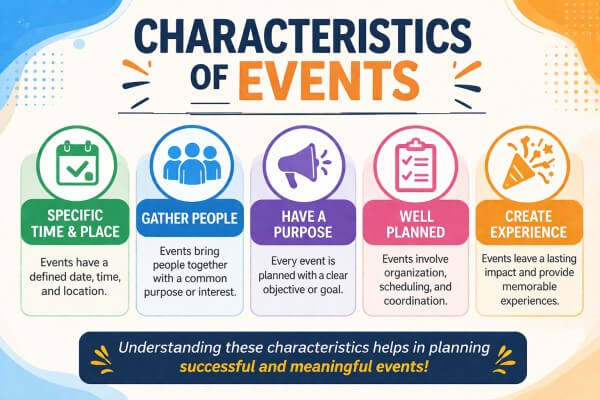
We could identify the key characteristics of events as ‘non-routine’, ‘unique’, ‘one-time’ and a ‘one in a lifetime’ experience for the participants. You would have also ascertained that events are generally expensive to stage and require long and careful planning. While planning the event, the purpose of the event, the event theme, the venue, the audience, available resources, the timing of the event, and the skills of the team have to be considered. The demands on an event manager are far greater than one could expect.
Some events take place only once or are held annually / biannually usually at the same time every year. Many of them carry high level risks, including financial risks and safety risks. There is a lot at stake. Every performer whether athlete or entertainer wants to deliver her or his best performance. On her wedding, the bride wants the day to be a perfect and memorable one. The marketing manager and the design team want the new product to be taken positively by the consumer. Imagine a big budget product launch where there are 500 key industry players and the media are in attendance. If it is taking place at a fancy or unusual location, what would be the demands for logistics, lighting, sound and special effects? These are the challenges that come up while organizing events, just to name a few.
This also suggests that events have certain characteristics inherent in them. In order to understand events better and to deliver a successful event, it is important to learn about these characteristics.
Characteristics of Events
The characteristics of events will be dealt under the following headings: A platform for interaction and networking; Uniqueness and perishability; Entertainment, ceremonies and rituals; Labor intensiveness, networking with vendors and teamwork; Fixed timescale; Financial planning; Ambience; Creative edge and the ‘Wow factor.’ It is important to understand these characteristics to ensure the smooth running of the event, to minimize risks and to maximize the enjoyment of the event audience.
A Platform for Interaction and Networking
Events play a significant role in bringing people together for specific purposes such as brand building, charity, fund raising, ceremonial activities, rituals, image building and much more. Consumers of goods seldom get a chance to meet people who produce the goods in manufacturing units. Events are the best platform where the target audience or the consumers get a chance to meet the producers of products. The products are brought to the end user through innovative methods and interaction. For example, the product ‘camlin’ besides getting advertised, was introduced through demonstrations, drawing competitions and road shows, covering most of the schools. The crowd at a wedding, birthday party or a new year party will not just be interacting with each other, but also with the hosts and perhaps with entertainers. This creates an atmosphere and makes the event enjoyable. Similarly, the crowd in a cricket match contributes to the whole experience by cheering and interacting with itself, sometimes with the participants, staff and so on.
It is necessary to create the event based on the kind of people who are going to be a part of it, because an event’s success or failure is attributed to the actions and reactions of people attending the event. The same event that was successful, if repeated, may be a success or failure depending on the background of the audience, their interactions and reactions. Hence a vital aspect that has to be considered by event planners is the kind of target audience.
Creating Live Experiences
Human life is filled with experiences. Events aim to provide memorable experiences. They create experiences for attendees of events like weddings, sports events, festivals, road shows and so on. Events activate brands, businesses and customers. When we read the newspaper or watch television, we are simply ‘seeing,’ or ‘seeing and listening.’ When we play the radio, we only ‘listen.’ An event provides a multidimensional communication to the brain by providing experience. Hence it is only an event that makes us ‘feel.’ Every experience provided by events is unique. The latest trends in activations, IPs, managed events, weddings, MICE, digital events and many others, is experiential. This is because the available technology is affordable and effective. Hence, we get to see more of live and experiential. Experiential is about providing live and immersive experiences. The experiential aspect makes the event more engaging and fun. Marketers use live events to tell their brand story. Creating an experience that connects the brand and target audience is called experiential marketing. The event manager is expected to provide strategy, development and management of communication technology that creates memorable experiences for the consumer. Event managers help build brands and sell products in this way.
Uniqueness and Perishability
Every event is unique in its own way as every event is a different experience to the audience. No two events are the same. Even if two weddings were to be held by the same organizer on the same day, in the same city, they would differ in terms of timings, number of people visiting, the way people interact etc., hence the two weddings would be radically different. Likewise, the response towards a rock show by a renowned artist in a city might not be the same in another city. This is because the location, demographics, arrangements and audience response might not be the same in different places, hence giving the rock shows by the same artist in different cities, their uniqueness. A memorable event is unique because of pleasant happenings to cherish and a successful audience response, thus generating the desired impact and outcome.
Just as events are regarded as unique, they are also considered tremendously perishable. No event can be repeated the same way. The International Filmfare Awards or Oscar Awards held every year might not be similar to the one that was held in the previous year. Events like workshops, seminars and brand building, though mostly organized by Event Management Companies (EMCs) in a particular way will be different on every occasion, while being brief and time bound. Perishability also relates to the use of facilities for events. Let us suppose we have a banqueting room for weddings. Its peak usage might be on Sunday evenings for weddings, and so on the remaining days of the week, its revenue generating potential may not be exploited. Hence for the remaining days, the revenue-generating potential of each day is lost forever, thus suggesting that it is perishable. The day on which the hall is empty cannot be replayed and used for an event, another perishable characteristic.
Events like the LIC Zee Cine Awards, the Lakme Fashion Week, Sunburn, Mahindra Blues Festival and IIFA are popular and unique event properties. Further events are also exploited via multiple mediums like webcasting, internet, audio and video programs. Hence an event manager’s role would be to ensure the extent of facilities and services that can be used effectively for the event, because of its uniqueness and infrequent occurrence. Because of the perishable nature of events, events could be expensive to provide. The cost of losing an opportunity in event management (often referred to as loss due to perishability), can be countered by many event managers, by applying different techniques. Differential pricing or discount days are used to draw in business in cycles or days when the business trend is low. For example, the ‘Kingdom of Dreams’ in Gurugram, Haryana, offers discounted rates for its entertainment shows on weekdays.
Entertainment, Ceremonies and Rituals
Entertainment is the essence of most events. For some events entertainment is central, for others it is peripheral i.e. secondary in importance. Entertainment when used in any event should serve its purpose. The needs of the event audience must be carefully considered when making this decision. While the sole purpose of some events is only entertainment, such as festivals, carnivals and musical concerts, entertainment is used as a strategy to create momentum and enhance the beauty of events like fairs, weddings and charity shows. Some forms of entertainment go well with diverse kind of events. A ‘theme’ / fancy dress code can be considered for an anniversary or a wedding party. However, the same idea can work extremely well for a business success party.
A major characteristic of events that makes them special is the ceremonies. If we look at the past historical events, rituals and ceremonies always played an important part. The ceremonies we see today are the reinvented versions of old traditions. Often the rituals and ceremonies are there because they emphasize the continuity of tradition. On January 26th every year, the Republic Day celebrations are celebrated with ceremonies marked by traditional openings and processions. The Golden Bears, Golden Globe or Oscar Awards have prizes given for good filmmaking, acting, production and direction, and the whole ceremony is specially made up of performances. Similarly, weddings are made up of rituals and ceremonies based on the tradition that is passed from generation to generation. Based upon the size of the event the ceremonies could be large scale or small scale. New events with wholly new ceremonies are becoming a trend now to attract tourists in cities and towns.
The Oscars as an event have remained a tradition and become a ritual. This largest event in Hollywood that started in 1929 with black and white films, moved to color in 1966, with more hi-tech, more glamorous, more exciting, more thrilling and worldwide coverage. It is an event looked forward to every year by the best in the business.
Labor Intensiveness, Networking with Vendors, and Teamwork
Depending on the scale of event, the event is planned and staged. The more complex and more unique an event is, the more likely it is to be labor intensive, both in terms of organization and operation. The skills of the event team are very important for concept development. Right from complicated planning for efficient service delivery of a good event (events may be outsourced to caterers or other suppliers), to the operational level where high levels of staffing are required for proper delivery of the event, most events are labor intensive. The event manager is supported by a team that sometimes grows enormously as the event draws closer. A planning team of 10 members that works together for a year might suddenly grow into a team of 200 members during that short period of the event. This phenomenon has been described as ‘pulsing organization’ by Toffler. For example, the small catering team for the 2002 Olympic Winter Games expanded to over 200 (including volunteers) in the month before the games. It also provided only one opportunity for the entire team to be together for that short time span for a training session.
Another key characteristic is the network with the vendors / supply chain. EMCs are the essential link between client and vendor. They have the ability to source, negotiate and get the work done by the vendors who are various service providers. There must be a commitment from the supply chain to offer the latest and most efficient solutions including technology. Being able to identify the right type of vendor for a particular requirement determines the EMC’s ability to deliver quality work.
The staff working at most events have limited opportunity for training, hence job breakdowns and task sheets become essential aspects of planning. This requires high level of communication between the team members, even where the event may be repeating a well-known formula or operating within a common operating framework such as a conference. A wedding reception in an open space of 400 people will not only require catering staff, but also jockeys to conduct a musical evening, cleaners and staff to set up and break down the set up. Hence the importance of team structure is crucial to successful event management. A host of skilled and unskilled staff need to be guided effectively. Staffing needs are also likely to peak at certain times. An event manager will have to forecast staffing needs directly from the requirements of running the event.
Functional level responsibilities need to be addressed within the team for a specific event. For example, a gaming event such as an athletic competition will require a completely different staffing structure to support it (including competitions, judges, timekeepers etc.) than a grand traditional wedding which would have more of catering staff, lighting technicians etc. Besides the above, stakeholders such as police, emergency services, the environmental protection agency as well as local transit authority have all sorts of requirements that would challenge the feasibility of the event, and these must be investigated.
Fixed Time Scale
Events have a fixed time scale and are not like routine activities that can be carried out indefinitely. In short, events do not go on forever. The timescale could be very short, such as for the opening ceremony for a new road, or very long, as with the Olympics or Commonwealth Games, where the planning phase took about five years or more. Events could go on for a month / month, a week, two days, an entire day or an evening, or even for an hour. The timing of the event determines the kind of event that will be held. If it is an evening event, the kind of lighting, decor, stage set up, the color of backdrop, seating arrangements, flower arrangement etc. will be different as compared to these arrangements as per day requirements.
While planning an event, time requirements regarding preparation for the event pre and post, wrap up etc. are decided by the magnitude and size of the event. You will have to work out the schedule of the event because you need to know how long an event will last, whether it will be for an hour or two, what will happen during the event and how much time each activity in the event will take. The criticality of right timing is to be kept in mind. Imagine a product launch where the product is revealed while the chairman is still introducing the product, when the schedule specifies that the product reveal must happen after the speech. Sometimes, the fixed timescale also gets varied, particularly in events that have an informal setting. A birthday party, may carry on longer than intended because ‘it just happened.’ Sometimes a formal event like a fair where there are many stakeholders, may get extended in a planned way for some special reason, e.g. to recover the costs.
Financial Planning
Financial planning is very important for the event. It depends upon how big the event is going to be and the number of visitors attending it. It also depends on what it will cost to hold the event and whether it has to be profitable. Every event differs in the way it is priced. This issue of pricing is very important as inexperienced organizers typically underestimate the various costs. This is why accurate and well thought of budget should be negotiated and finalized by the EMC with the client before the start of any activity. It is a crucial factor in controlling costs within budget and ensuring efficient resource utilization. There is a tendency on the part of everyone to say, “Oh well, it will cost about….” without actually checking. When someone does get around to checking the real amount, it comes as a shock. Every event has a level of risk associated with it. The scope of pricing an event depends on the level of risk the event organizer is ready to take. This helps in doing the pricing for the clients separately and pricing the tickets for the target audience separately. Sometimes the organizers keep the ticket price low and land the event in serious financial difficulties. The ticket price has to be based on actual costings.
A calculation about the break-even point of the event should be included in the budget and cash-flow statement. This can be achieved through break-even analysis. Break-even analysis is the comparison of production and selling expenses against the sales projections on a market-based price. This helps in finding out if the event is worth carrying out. In case of ticketed events, it depends on how many tickets can be sold and at what price. For this, calculation of the breakeven point has to be done. For example, if the ticket prices are INR 10, and the costs are INR 600, for the event to be break-even, this means that 60 tickets have to be sold. What if the seats at the venue are only 55 instead of 60? You will not make profit. Hence, once the full costs of the event are known, the ticket price can be calculated bearing in mind that enough tickets have to be sold to cover eventualities. There could be cost risks related to quality management and standards, cost risks related to the expense of putting on the event, and cost risks related to the effective timing and scheduling of events.
Ambience
Ambience is that very essential characteristic that seeks to ensure whether the event is a success or a failure. At a personal event, such as a birthday party, the ambience may be simply created by the people who are there, without the need for anything else – good company amongst friends can make an excellent event. However, for many events, the right ambience is created by the desired services. The presence of expensive venue, themed decor, gifts, foods and games might not necessarily make an anniversary party a success. A well-organized event can lighten up the moods of guests who have had a busy day or have travelled long distances to reach the venue. The event manager has to employ enough creativity while blending these services. Careful attention has to be given to every detail and by trying to bring out the desired outcome.
Creative Edge and the ‘Wow Factor’
The greatest skill for the event manager is to use creativity in providing an event. Ideation and creativity are the key strengths of the event industry today. A wedding planner will use a color theme to emphasize the mood or symbolism of the event. The staging of events in a creative manner shows the event manager’s creative skills. Events typically have a team-based work environment and a project type of organization structure. Once the event concept is finalized with the client, the very first step begins when the creative conceptualizer works on ‘the brief’ with the creative team. A brief is a detailed list of input and specific instructions from the client for the event. The creative team also has to work with hard practical realities such as the logistics, like transportation of material, travel, stay arrangements etc. and the networking aspects, namely media plan, ad designs, ticket designs, printing etc. With these constraints the creative team tries to create the perfect picture of the event. Indian sponsors are looking for innovations in properties every year, with the help of creativity. Creativity as a tool is required by advertisers, is essential for growth of revenues and retention of business.
The first edition of the Jaipur Art Summit was held in November 2013 at Hotel Clarks, Amer and Jawahar Kala Kendra, Jaipur, in Rajasthan. The summit showcased creative expressions across many media and formats like canvas, visual and digital art, art installations, sculptures, interactive art, other contemporary and folk centric expressions. The works of 150 artists were showcased including senior renowned artists like Anjolie Ela Menon, Jatin Das and Jai Zharotia. Features like art camp, installation art works, seminars, display of folk traditions and art ‘haat’ (market) were different elements that gave a creative touch to the summit.
The ‘Wow’ factor of events is an essential characteristic, which owes the event a memorable experience. For example, the ‘Wow’ factor can be created by using an interplay of unusual venues, artistic expressions in decor, other creative touches and activities that can make the event a success. Venues are also used to reveal the message or culture of a company, like – a contemporary and futuristic building for a new and trendy company, and a historical building for a traditional firm. For example, the Roundhouse is an 1846 steam engine repair-shed, in North London that was at the heart of the swinging 1960s scene with famous rock-n-roll bands like The Rolling Stones, Jimi Hendrix and The Doors, all playing there. In recent years, product launches, award ceremonies, the ‘X Men’ movie premiere, video productions and Music Week Awards were held there. Clients for events like brand promotion, annual corporate events and product launches prefer to choose unusual venues like palaces, historical monuments and ‘havelis’ (old traditional big homes), museums, etc. that raise the curiosity of audiences and give a wonderful feel to the event.
Impact of Events
Events have a range of impacts, both positive and negative on their communities and stakeholders. The event manager needs to always identify and predict these impacts and then manage them to bring about an overall positive impact from the event. Impacts on the social, economic, cultural and political framework of the destination should be carefully assessed as a critical planning tool to events. Good communication and consultation with local authorities, while keeping religious and cultural sensitivities in mind are important aspects in selecting the event destination and organizing it. Logistics, crowd traffic flow and event venue planning often are the critical areas, where errors in planning can lead to huge negative impacts.
As mentioned in the historical contexts of events, in earlier times, events used to be more social in nature, example weddings and this was a big source of social interaction between people, hence bringing around a clear social and cultural impact on society. Apart from the social aspect, there were larger events of religious or political nature example, the Kumbh Mela. Such events bring pride to the community and broaden people’s awareness and cultural horizons. Contemporary events are seen more in the light of the community, and event managers are focusing more and more on bringing benefits to an entire community through footfalls, tourism and more business for the local community. Some events, especially sporting events like the Commonwealth Games play a political role, in addition to social and economic roles. There is considerable competition to stage the games, and they bring in significant impact on the national image of the country, in addition to economic, social and commercial benefits. Destinations are often chosen keeping in mind the local weather, culture, and tourist attractions for a particular event. For example, Goa is usually the destination for International and National Film Festivals, or Media Summits. The environment and culture in Goa, especially during December (carnival time) enables the right atmosphere for a fun filled and creative environment for these events. An ill planned event can have huge negative repercussions, and the larger the scale of the event, the larger is the impact. Stampedes and crowds going in a panic have often been seen in very large mass events like the Haj at Mecca, or the Kumbh Mela, where unplanned logistics and crowd management have resulted in disasters with many people dying. This leaves a huge negativity to such events.
Economic implications and impact on a community or city can be huge, due to a major event. An event, in itself may or may not provide direct employment, but the indirect effects on local businesses, services and infrastructure can be extremely significant. Events are seen as catalysts and marketing tools for attracting visitors and tourists, while creating profiles for destinations. Many events, after analysis have proved that a large chunk of the income came from tourists, and various merchandise and related items with the event theme being sold; as also with the local restaurants, hotels and other shops gaining hugely during the event. Support services like transport, taxis, equipment vendors, photographers and videographers, contractors and other type of suppliers also see huge upsides in their businesses. In destinations which host an event on a regular basis (annually), there is a marked positive impact on the tourism aspect, and this tends to extend much before and after the event time period. There can be huge developmental impacts from a large-scale event, like the Commonwealth Games held in the National Capital Region of Delhi in 2010. Work started many months before the event, and the positive changes in transport, infrastructure and facelift of the city extended much beyond the event. This had a permanent impact on the facilities provided by the city.
Political implications of events have also been huge, right from historical times. The Roman Gladiator games in Rome were political in nature, and the ability of the Roman Emperors to put on a major spectacle of a huge scale contributed much to their royal status. In today’s time too, holding of global events like the Olympics, or World Cup Cricket and Football events speak much about the political status and superiority that the hosting country enjoys. The politicians and ruling governments get a platform to showcase their popularity, success and achievements during inauguration ceremonies in these events. Media coverage on such events, which include a lot of information on the host city and country, showcase the economic, social and cultural development there, which all goes as political benefit to the government at work. Shrewd politicians and governments always have an eye on large scale events that will keep the population happy, and themselves in power. They use hallmark events to highlight their coming into and going out of power, as these events are retained in public memory for a long time. Such events could arouse nationalism, patriotism and are eventually linked to the government as a positive impact. Corruption arising out of politics can have negative impacts on an event too, example the negative publicity that came out of media coverage of the corruption in the Commonwealth Games in Delhi raised many question marks on the integrity of the organizers, and the ruling party.
The event planner holds the critical task of assessing and balancing all the above impacting factors. Social and cultural factors, along with economic and political issues could have positive outcomes if managed well, but could bring about negative, and sometimes disastrous results if not managed and planned well. Governments also need to have a long-term view while planning mass events. Though these bring huge social, cultural and economic benefits and urban development, the governments need to assess long term political and social impacts, while keeping costs and integrity of managing these events in mind. However small or large scale the event maybe, one cannot ignore or overlook the criticality of planning and analysis of all the above factors, which may impact the long, medium or short term social and economic environment.
The Advantage of Events
You have so far learnt that events generate social, economic, cultural and political impacts. Through these impacts the vast majority of events serve to improve and enhance our society at a time of significant social change. A look at the various types of events reveals that events are used for developmental purposes besides being used for cultural, recreational, enjoyment and celebration purposes. A well-crafted wedding provides us the advantage of a memorable experience that lingers on for years. Cultural celebrations are greatly promoted, because of their success in terms of openness, free entry and informality in most events. They provide great opportunities for interaction, reach, are beneficial to sponsors, and open up new marketing horizons for the corporate sector. Talent shows and award functions enable the promotion of arts, entertainment and enjoyment. Events that are used for image-building, to support tourism, or improve the environment have a positive outcome. Events like garden festivals are useful as a mechanism to regenerate rundown areas. Thus, events provide innumerable opportunities to ideate and create. The effective networking of the event managers with the right vendors or suppliers are highly advantageous to events. Efforts should be made to establish a relationship on a long-term basis with a commitment to a partnership approach between the EMC and the vendor.
As a marketing communication tool event helps us overcome problems associated with traditional media. Events have the ability to bring together well-defined participants. A specific number of the target audience could be invited or could buy tickets for a show specially created for a particular profile of the target audience. Since the audience is actively targeted, the option of controlled reach can be exercised. This leads to lowering of the media networking budgets and focused communication with the specially gathered audience. Live media communication enables interactive communication. Live media communication is a complete sensual experience as compared to a press advertisement on TV/ Radio commercial. This is so because a press ad is basically a flat piece of paper and a commercial is just an audio-visual experience. The high recall value of live media communication used in events is very advantageous. No wonder events are called as tools for ‘experiential marketing.’ Experiential not only integrates a number of mediums together but offers a great degree of personal connect. A consumer is more likely to have a greater sense of brand recall and brand loyalty after experiencing a product in a favorable environment. The word-of-mouth publicity of a memorable event suggests that the event has been professionally carried out.
One of the greatest advantages offered by an event is the involvement of all the senses while experiencing the event. When the audience participates in an event, they get to see and do activities happening (in real time), hence the ‘feel good’ factor and ‘thrill’ sets in. Events have the greatest advantage over other media, by boasting of instantly collecting feedback. Being a live media, it is possible to feel and deduce the reactions of the audience to the objective that the event was meant for.
Above all events can be easily customized. This means that specific traits of the local inhabitants can be incorporated in the core concept and design of the event, to ensure that the event is socially and culturally in tune with the local culture. The advantage in terms of post-event publicity that events can offer, apart from the media involved in the event, is the benefit associated with reports of the event in the newspapers and news on the electronic media. For such reports there is no extra cost to be borne – neither by the sponsor nor by the event organizer.


