Communication Skills and Methods
Introduction
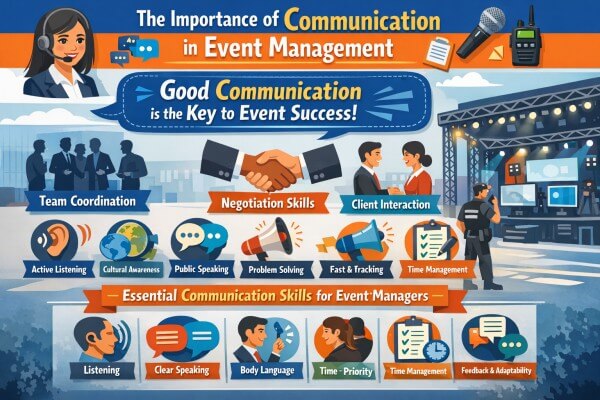
In Event Manager As A Professional Leader, you had learnt about the competencies required to become an event entrepreneur. We had also discussed how working with the team, networking, negotiation skills, technical skills, interpersonal skills, body language, language skills, service orientation and handling of pressures are essential qualities for the event manager to become a professional leader. Besides the above skills, time management, problem solving, decision-making and evaluation are important skills, required for an event manager, irrespective of the type of event being handled. A skill that is common to all these skills is communication skill. In this post we shall learn how good communication is the key to every event’s success and how we can improve our communication skills.
Importance of Communication
The term ‘communication’ is not just about what we say but how we say it too. It includes our body language and the emphasis we give to different images or symbols along with the words. In other words, communication is a combination of the message we wish to convey and the manner in which we do it. But more importantly it is what the receiver (the reader, the listener, the observer, or the audience) understands by what we are trying to express. Communication is, therefore, the effective exchange of different messages resulting in a degree of shared meaning, shared understanding, and even shared enthusiasm.
Effective communication is one of the core capacities which are integral to the way an event manager works. It can result in higher productivity. Communication can happen between different people, for different purposes and in different ways. For example, flags are used to communicate messages in car races. Similarly, personnel who work for safety, security and operations are connected through phones. An event planner who effectively communicates expectations and goals to employees is more likely to have employees who will have a better attitude at work and produce quality work on time, or ahead of schedule. Hence, the survival and credibility of many event managers, depends on their ability to communicate effectively.
During the event management process, various stakeholders whether they are clients, team members, vendors or the media, are constantly sending important information to the event manager and to each other at all times. Transmitting of correct communication enhances the efficiency and success of the entire event process. All event managers for this reason face the challenge of developing communication strategies for free flow of information and ideas. Proper sharing of information also plays a key role in the success of event planning and execution. Event managers combine their organizational and communication skills and manage all the complex details of any event from planning, budgeting to evaluating afterward. They have to share their ideas / visions openly with their clients and team members, accept their criticism and be open to new ideas.
An event manager who is an effective communicator, is likely to achieve what s/he wants. We spend over 80 per cent of our waking life in sending or receiving information. The likelihood of problems and conflicts due to incorrectly interpreting (understanding) the message could be greatly reduced if one has good communication skills.
Communication Skills for Event Management
Events are all about people. In order to be professional, the event managers have to be communicative at all times. Good communication skills imply that the communicator (here the event organizer / coordinator / manager) makes messages / instructions simple and understandable. During event planning, and at the time of the event, it is important that everyone has a common understanding of the message. Event organizers thus develop confidence in communicating at all levels, with both individuals and groups. For example, an event manager, organizing a corporate event will be in constant touch with the clients, by keeping them up to date with the latest developments / arrangements and by answering any questions that they may have. They need to act with total integrity in every situation because clients place a great deal of trust on event organizers. By being in regular touch with all the suppliers / vendors working on the event, it is conveyed as to what is required from them and how they fit into the event as a whole.
For the event management team, the event manger should be easy to talk to and should be someone you want to work with. Effective communication helps build relationships with all those involved in the event regardless of how small their contribution is.
How to develop Good Communication Skills
Good communication is not an isolated series of one skill; it involves several skills. For example, speaking involves not only getting our message across but also being able to listen and understand what others are saying (active listening) and observing the verbal and nonverbal cues in order to monitor the effectiveness of our message. Multiple skills make communication effective. Effective communication includes basic skills in listening, speaking, correct body language, questioning and sharing feedback. These can be developed with some concerted review and practice. Following are the points that have to be kept in mind while communicating:
Communicate with the right person
The person who picks up the phone may be very nice but if that person does not have decision making power, the contact will not lead to any desired results. Communicating with the person having authority would be effective in communicating one’s ideas and proposals.
Keep in mind the cultural backgrounds of people
Working with people of different cultural backgrounds influences one’s way of working and communicating. Likewise, guests attending an event may belong to different regions or countries. These backgrounds must be taken into account. Some gestures could be pleasing to people belonging to one culture but can be offensive to others having different background. For example, kissing women on their cheek to greet them may be a norm in western culture but may not be acceptable to people belonging to other cultural backgrounds. Cultural sensitivities of people should be taken care of while interacting with them.
Empathy
As communicators, we should try to put ourselves in the place of receiver and understand from the receiver’s perspective. This way we can understand the receiver better and react positively to them. It also helps in eliminating possible obstacles while communicating. Communicating of feedback should be made easy. We should give them time to react, give them the right contact numbers, take away their fears, but be clear about what we expect from them. It is vital to keep one’s promises. The promise has to be realistic. If we cannot comply with the deadline or cannot keep the promise, it is better we tell the client about it. It is better for them to hear a “no” from us than to hear nothing at all.
Good communication is also the key to the implementation phase of the event. It is impossible to communicate in person with a large number of people at a time. Therefore, many forms of communication may be used to help ensure people know what to do: briefings about plans, the event program, emergency procedures etc. The logistics officer, working with the marketing officer and the overall event coordinator must also organize pre-event meetings and use communication tools such as site maps, bulletins and newsletters to help get across major issues to staff, crew, artists, volunteers and helpers, in order to achieve coordination of efforts.
Develop Conversational Skills
They are important when working on several projects at a time. The way you speak to your clients and your team will define your conversational skills. This also includes telephone etiquettes. During event planning stage, communication problems amongst team members are quite common. In order to avoid such problems and develop strong conversational skills, doing the following is necessary:
- Improve listening skills.
- Try to overcome any language barriers.
- Read the body language of people.
- Do social networking for benefit of self.
- Influence the team to improve performance, by interaction.
- Deal with conflict at workplace.
If you have effective communication skills, then half the job of hosting the event is done. Polite and courteous behavior will leave a positive image on the client. This also works by showing patience when the client is in an angry state. Simple and good communication skills will enable people to find it enjoyable to work with the event manager. It is the event manager’s job to make sure that this happens.
Communication Requirements in Events
A professional event manager uses a variety of communication methods to keep connected with internal and external people involved in the event. You need to know what is going on outside the event that could affect what is going on inside the event, and vice versa. The means of maintaining this connection and communication can include high-tech and sophisticated systems, such as computer networks and closed-circuit television surveillance, and / or low-tech methods, such as designated personnel who go around the event, observing the crowd, and activities. The level of connection depends on the type and needs of each event.
The pre-event communication involves understanding what motivates the guests and the attendees. This means that s/he needs to provide to her / his team the information required to facilitate successful participation of people in the event experience. S/he must communicate the basics – who, what, when, where, why, how, and how much. S/he also needs to prepare the attendees or guests for the experience, furnishing the directions, instructions, and recommendations that will enhance the experience. S/he needs to convey and repeatedly remind her / his team the purpose of the event and build the excitement for the participants to enjoy the event experience. As a good communicator, s/he will build the mood and develop an appropriate strategy to create audience’s interest in the event. For example, should the first pamphlet, poster or flyer of the food festival be prepared a month prior to the event or a year before the event, so that these can be provided to the local tourist agencies, and stores, who can in turn give them to potential visitors, tourists or tour operators? Excellent communication skills also mean that the event manager is able to change or modify the message or change the way of conveying the message.
On-site communications mean the normal information exchange that is required during the event and must also be set up for a quick response to an emergency, should it occur. Throughout the event coordination process, there is a constant flow of information. The on-site communications need special attention as these happen during the busy hours just before, during, and just after the event. For example, it would be sensible to designate (and train) a spokesperson to respond to the media in times of crisis and create access to controls to prevent damaging or distressful footage from being broadcasted.
Events that are large and which take place in arena-type venues (large grounds / open areas), may require communication to happen between more than one technician and coordinators. A communication ring is useful at such times. This is the chain of links between different people involved in event management. For this the crews should be given sufficient time to set up communication systems or possibly radio communications if needed, in the case of large events. To support this mechanism, the logistics officer, while planning the provision of communications, can prepare a list of contacts consisting of internal team members and external members (stakeholders). This list can be built up as the event is being created and acts as an event phone book, without the need of bits of paper or diaries with contact lists.
Communication makes it possible for the event to become user friendly by making communication channels clear and accessible. For people with special needs (disabilities such as mobility, sight, hearing, speaking,) the professional event coordinator must ensure that the event and the site are ‘user friendly.’ This has to be done with a lot of sensitivity towards their needs. To ensure effective communication with individuals having hearing, vision or speech impairments, services or devices such as qualified interpreters (who convey to them the meaning), assistive listening headsets, television captioning and decoders, telecommunication devices for deaf persons, video-text displays, readers, brailed materials (for visually impaired) and large-print materials could be used.
Communication will be the key to success while dealing with human resource personnel, right from the initial interview through their training and to their performance evaluation. You as an event manager should be clear about your expectations from them, about their responsibilities, their salaries, and the purpose and outcomes of a successful event. As a professional, you must create and communicate an atmosphere of trust, respect, teamwork and appreciation for a job well done. For a large team working on an event, a website could be created for ‘team members only’ for access, where important announcements, messages, dates, training sessions, profiling of members, and important leaders, staff and volunteers who got recognitions for their work could be included. It could even include on-line training programs and electronic version of the policy manual of your event management company.
Adopt an approach that facilitates two-way communication for the employees’ performance evaluation. You need to check regularly on the progress of tasks delegated to them. Talking to team members regularly, even informally, about their jobs and how they can improve their performance would be beneficial. You must bring in feedback mechanisms (in oral or written form) that allow workers to seek guidelines, additional training and contribute suggestions. If they are facing any problems, their answers can help in improving the training program, by your answering to their needs.
To understand the channels of communication better, one needs to look at the organizational chart that is segmented into various components or departments. These components provide the hierarchy of communications on-site at the event. The organizational chart should be combined with the site or floor plan of the event venue, and with the event schedule. This will make it easier to understand the communication channels when the event is going on. These channels should be strengthened with a contact list, including the telephone numbers and frequencies of radios or other equipment, assigned to each contact person. It must be conveyed clearly as to who is to implement contingency or crisis plans, and who will respond to media if an incident occurs.
In terms of security operations, communications are facilitated through golf carts or bicycles in the event site. By making communication channels clear and accessible, and making safety a top priority, everyone can ‘speak up’ (speak up individually) and speak to the contact person concerned for hazards and emergencies. The technologies that facilitate communications for security are two-way radios, cellular phones, and for noisy environments, headsets, hand / collar microphones and earphones. Nowadays for the purpose of security, metal and motion detectors are used for screening people at the entrance. X-ray screening is done for packages or baggage. Remote or passive security means equipment such as closed-circuit television (CCTV), cameras, motion detectors and intrusion alarms (to alert personnel/ staff for any person who enters illegally). The camera is a labor-saving device and there are rules as to where, when and how you are allowed to use it at the venue.
Methods of Communication
We all know that there are many methods to convey messages. An event manager uses various methods to communicate during the planning, implementation and post-event stage.
Verbal Communication Methods
This is oral communication that involves use of words for communicating. It could be said to be the most used form of communication. Whether we have to present some important data to our colleagues or have a meeting with a client, these skills are vital. We are constantly using words verbally, face-to face or by telephone, to inform our clients, vendors or to the guests. The person on the receiving end would also need to exercise much caution to ensure that s/he clearly understands what is being said. Thus, for effective oral communication we would need to cultivate both our listening and speaking skills, as we would have to carry out both roles (of speaker and receiver) during event planning and execution. These skills are necessary for interactions with both individuals and groups. There is a need to gain the client’s trust and share a working relationship. To fulfill these objectives, the event manager has to be friendly and professional. The ability to relate to the client at a personal level lead to a great and lasting professional relationship and is an added advantage for success in the long run. Some of the important oral communications which an event manager should consciously improve upon, are as follows:
Public Relations
Strong interpersonal relations are built with frequent professional interactions and working together closely with the team. Aspirants of event management will have to develop public relation skills at an early stage, through experience and practice, as they cannot be developed overnight.
The role of public relations (PR) is also to manage the organizations and the event’s image in the mind of the audience and the public. This is done mainly through press releases. With the help of up-to-date information sources and photographs, the media gets the background information needed to develop stories about the event. Media briefings can be conducted before and during the event, particularly if high-profile people like celebrities, entertainers and athletes can increase publicity. A very critical and challenging role of PR comes when there is a need to inform the media about a negative incident. The incident-reporting system can play a role in this regard by informing senior members, team members or the PR manager. In some situations, words have to be chosen carefully. Hence the PR role can be a sensitive one. For example, a simple statement of regret would be more tactful than giving the cause of an accident. An important role in PR is the entertainment of guests or VIPs attending the event. Here, as a host, you need to take care of the following: be attentive to the needs and expectations of the guests; be able to make easy conversation; be mindful of their cultural backgrounds and expectations; provide them the information / help they need; and design situations in the event to meet the protocol of the VIP guests (such as their security needs, seating arrangements, space, serving of foods and beverages etc.). As a multicultural host, you need to show respect; relate to people by understanding them and making them understand; show empathy; not make generalizations about the places from where people of different countries come; and be patient and courteous. The other situations where PR is required are making travel arrangements by telephone or email, welcoming delegates at airport or event venue, running meetings, entertainment during meals / events, and providing commentary during tours. The benefits of PR should be to the satisfaction of customers at all levels. The above activities also help largely in promoting the event.
Public Speaking
Public speaking is a process of speaking to a group of people with the conscious intention to inform, influence, convince, motivate or entertain them or to negotiate with them to achieve a desired, preplanned objective. Public speaking is usually face-to-face communication between people with a purpose or predetermined objective.
These skills are important for convincing or negotiating with the clients or just to get them interested. These skills are highly useful while addressing the media or during press conferences which are held usually after a public event. The major benefits of these skills are:
- To negotiate with the client to get business, to engage vendors and event performers.
- To motivate team members or potential attendees for their greater participation in the event.
- To seek the involvement of more people at every level like getting volunteers for the day of the event.
- To transmit information to a group of individuals like potential clients, team members, larger audience or invitees.
- To train and educate the event team members in improving their efficiency and generating better coordination.
Personal Meetings
Successful meeting management is an important management competency essential for every event manager. Managers must understand situations that require meetings; the types of meetings; how to plan, run, and close meetings; and how to manage activities after meetings. Furthermore, managers should be able to troubleshoot problems that arise from organizational meetings and know options for technology-enabled meetings. Personal meetings happen face to face in a same room or via electronic media like video conferencing, e-mails, telephone usually to negotiate or to make decisions by consensus. An effective meeting is the one which takes only as much time as is needed to accomplish its goals, where the discussion is focused on its purpose and these goals are achieved by mutual consensus and agreement.
The agenda for the meeting should indicate the desired outcome of the meeting, the major topics to address, and the type of action needed. We may also want to list the names of the participants next to an agenda item. For example, an agenda item might be: ‘monthly update on event design.’ This will give the participants a better idea about the duration of the meeting.
To conduct a successful meeting, we must start by stating the objectives clearly. If the meeting is aimed mainly for persuading a group and not just informing them, give more thought to the audience profile. Once the meeting starts, it’s our job to guide the discussion and keep the meeting on track without letting the participants go off track. This requires a delicate balance of both control and flexibility. We should also encourage participation from everyone and not downplay individual suggestions. Meetings don’t always resolve differences. Different perceptions may remain. We must underscore the key items i.e. what priorities were set, what specific steps are to be taken, by whom, in what period of time. If specific action is to be taken, we must make sure everyone understands what’s expected of them. Set deadlines for follow-up action. The ‘minutes’ (documenting) of any meeting should reflect these outcomes of the meeting, so that there is a record of tasks and responsibilities that were decided.
Briefing and Debriefing Meetings
Face-to-face meetings are a primary component of the on-site implementation, during the planning phase. The on-site meetings include the pre-con (the pre-event briefing), the post-con (the post-event briefing), daily briefings, and the all-important safety meeting. The pre-con meeting includes all the stakeholders of the event, and is a review of the entire event, its components, the design, the production schedule, roles, responsibilities and the outcome that has to be achieved by meeting expectations. The post-con is an after-event meeting, a review of what actually took place to resolve problems and then noting suggestions for future events. The daily briefing meetings are held on a regular basis for the purpose of updating plans and monitoring them, for all the functional aspects and emerging issues of the event. The safety meeting is the one where not just department heads or management of the subcontracted suppliers should be involved, but also the staff who are setting up and operating the equipment for the event. This is very important as usually these people are excluded or neglected from the chain of communications and hence do not receive the necessary safety messages. Safety meetings can help prevent accidents, and such meetings have high attendance and participation.
A functional network of all assistance methods called a command center should be created, so that problems and emergencies can be responded to before they become hazards. In the case of large events, this can probably be an office that is there within the event grounds, or a room that is specifically used for this purpose. For smaller events like a fundraising event or a reception, the command center can simply be a table that may be located at the back of the venue.
Technology-Enabled Meetings
Technology now allows people in remote locations to meet in a way that is similar to face-to-face meetings. Conference telephone calls and videoconferencing are alternatives when parties cannot meet in person.
Conference calls are made via telephone, and all parties are able to listen to and speak to one another. Many workplace telephones have the ability to place conference calls, and these calls are relatively inexpensive, especially when compared to the cost of an employee or client travelling long distances to attend a meeting.
The major difficulty associated with conference calls is the participants’ inability to see one another. Because of this, participants may not know who is speaking; therefore, it is important that individuals identify themselves before speaking. Another problem with not seeing others is that interruptions are common in conference calls; care must be taken to wait for each person to speak in turn. Finally, as with all telephone conversations, facial expressions and eye contact are not possible, and thus, the meaning of a person’s words may be lost.
Videoconferencing is done through an internet connection, and it allows participants to see and hear one another through a video or computer screen. In videoconferencing, unlike telephone conference calls, participants can see one another. However, many videoconferences have a short time delay, as a person speaking in one location must wait for the others in the other location to receive the message. This means that reactions to speaker may lag such that the speaker cannot easily understand the reaction to her or his words.
Written Communication Methods
Written Communication is used when we have to provide detailed information such as figures and facts, or while establishing proof of facts or contracts for future reference. It is also generally used to send documents and other important material to stakeholders. Written documents can be stored for later use as it can be recorded and easily referred. Important documents such as contracts, memos, and minutes of meetings are also in written form for this purpose. It can be seen in recent years however, that verbal communication has been replaced to a great extent by a faster form of written communication, and that is e-mail. Reports, contracts and other documents are prepared as a proof of understanding and for future reference. They are recorded carefully and mostly communicated through email and fax.
Combination of Oral and Written Methods
Advertising and Media Coverage: You must be familiar that advertising and media coverage can be both oral and written methods of communication. Advertising is used to communicate to people about an event and support the event’s image. Besides public relations, advertising and media coverage are used as marketing tools for events.
Presentations: While communicating an idea or blueprint of the proposed event to a group, presentations are used. They are also useful for self or company’s image portrayal and hence are essential with clients, training team members and volunteers. It is necessary for every event manager to acquire this skill. Presentations are also used to influence, motivate and impress the clients and stakeholders regarding plans and achievements. Some presentations are entertaining in nature. Developing the confidence to give good presentations, to stand up in front of an audience and speak well, will be beneficial during event preparation and execution. Just like public speaking skills, \ presentation skills can be developed with practice.
Conveying Messages through Theme and Décor
Themes are very popular devices that are used to convey ideas in a broad variety of events. Themes are used in exhibitions, festivals, birthday parties, anniversaries, fund-raisers, weddings, meetings, fairs, marketing events, other social events and sometimes even in educational events. Theme is a form of non-verbal communication that touches both our conscious and sub-conscious minds and emotions. According to Silvers, a theme allows us to quickly communicate a broad range of ideas and images based on widely held cultural assumptions and associations. For example, a wedding theme could be a traditional one representing the ethnicity of India. The persons getting married would follow the theme by wearing their traditional wedding garments, serving food of their state / region, playing their music and using traditional décor. The guests can wear traditional dresses that belong to their part of the country or state. A theme thus involves all the five senses – the sight, sound, taste, touch and smell, throughout the event design. Sensory cues such as sights (what we see) and sounds are mental or cerebral, whereas taste, touch and smell are physical. Sensory cues in an event environment may include the following:
- Sight – floral arrangements, colors, fabrics, setting, props, lighting, food presentation and garments of people.
- Sound – background music (instrumental or songs), noise of audience, dialogue, talk, discussion, musical entertainment, entertainment on stage, dining sounds (such as sounds of cutlery while eating, glasses clinking, crunchy foods etc.).
- Taste – food, beverage, atmospheric and olfactory aftertaste (in the mouth).
- Touch – fabrics, furnishings, surfaces (hard and soft) and food textures
- Smell – flowers, food aromas, aromas of room fresheners, scented candles/ incense / oils, fuels (cooking and power generators), and smell coming from people.
The event manager, with the help of the event designer should incorporate all the above five senses, by emphasizing and increasing the positive sensory cues and removing the negative ones.
The theme is established with the help of décor. Décor is the installing of design on walls, ceiling, floor, and architectural features of the venue. The designer may treat the setting as a ‘blank canvas’ onto which colors, lines, shapes and textures may be added. The right décor can transform an ordinary venue into a new environment and communicate important messages. Event décor is an art form that literally ‘sets the stage’ for the event experience.
Gestures or Body Language
It is another form of communication usually combined with oral communication to make it more effective. Our smile, our gestures and several other body movements send out a message to the people around us. To quickly communicate instructions, hand signals (gestures through hands) may be used between staff members. Using the right gestures while dealing with the clients, vendors, stakeholders and team members is important. We must always remember to maintain eye contact. This would show that we are serious and confident about what we are saying.
Etiquettes and Mannerism
Etiquette is a code of conduct of behavior related to the expected social behavior by a group. Manners are the expressions of etiquettes and involve wide range of social interactions within cultural norms. These are some simple rules regarding what to do or not to do to make others feel good and comfortable.
An event manager uses all these methods to communicate ideas and message to the client, team members, event attendees and others.
Communication using Technology
A professional event manager uses a variety of communication methods to keep connected with internal and external people involved in the event. S/he needs to know what is going on outside the event that could affect what is going on inside the event, and vice versa. This can be achieved with the help of high tech and sophisticated systems, such as computer networks and closed-circuit television surveillance.
Messages can be sent through audio mode or visual mode. Signs, message boards, posters, banners, video monitors and projection screens may be used to support verbal announcements that have been delivered to the audience. For recording, cameras and video recorders may be used to communicate a message such as for example, the arrival of a VIP guest or a celebrity or a performer or a surveillance of the audience in waiting or a waiting line at the entrance or a performance on stage or a brand launch and so on.
The Public Address (PA) System
The PA system is a vital link between the event and the audience. It plays the role of delivering information about the activities, of delivering promotional messages throughout the events and about important safety and emergency announcements in large events like annual festivals, sports events, fairs, exhibitions etc. The treatment given to these messages before delivering (through announcements) are important. A microphone is mostly used. For example, in welfare announcements such as lost child, instructing lost people to meet their families at a certain location in the venue; and in safety announcements such as evacuation (leaving) of venue, fire alarm, location of secure zones etc.; the messages should be treated and then delivered so that they don’t create panic amongst people. The tone and the wording of the announcements should be such that they don’t create panic amongst people. There should be a sequence of announcements depending on the urgency and severity of the emergency situation. The event manager should ensure that these announcements / broadcasts should reach all the required areas of the event site. These include inside and outside the buildings, corridors, toilets, dressing rooms, parking areas, conference / meeting rooms, reception, stairs and paths going into and outside the venue. Other kinds of communications to show emergency and evacuation are sirens and bells, and these should be followed by calming announcements to avoid panic amongst people.


