Types of Events
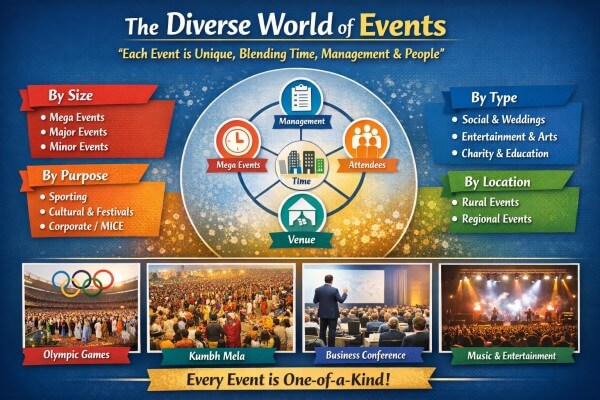
A look at the varieties of events that are happening around us help us to put them in categories based on their purpose or to a particular sector to which they belong. For example, mega, major, minor, activations, sporting, rural, social, entertainment, cultural, art, MICE, and so on. However, you would be surprised to know that every event has its own uniqueness and specialty and does not get repeated. Getz, who has done groundbreaking work in the typology of events, stated that “events are transient, and every event is a unique blending of its duration, setting, management, and people.” This suggests the blending and linkages between management, time, staff, attendees (people) and venue(s) for the execution of an event.
Categories Based on Size
Mega Events
The largest events are called mega-events. These are generally targeted at international markets and affect whole economies. Mega-events get extensive media coverage. Some good examples are the Olympic Games, World Cup Soccer, Maha Kumbh Mela and the World Fairs. Getz has defined Mega events as follows:
“Their volume should exceed 1 million visits, their capital costs should be at least $500 million, and their reputation should be of a ‘must see’ event… Mega-events, by way of their size or significance, are those that yield extraordinarily high levels of tourism, media coverage, prestige, or economic impact for the host community or destination.”
According to Hall, who specializes in research on events and tourism, Megaevents are defined as follows:
“Mega-events such as World Fairs and Expositions, the World Soccer Cup final, or the Olympic Games, are events which are expressly targeted at the international tourism market and may be suitably described as ‘mega’ by virtue of their size in terms of attendance, target market, level of public financial involvement, political effects, extent of television coverage, construction of facilities, and impact on economic and social fabric of the host community.”
Mega-events characterize of great tourism benefits due to their international outreach. There is an enormity of costs involved in organizing mega-events, thus making it difficult to calculate them accurately with so many stakeholders (mostly the government being involved). The Commonwealth games is yet another international multi-sport event involving athletes from the Commonwealth Nations. First held in 1930, the event has been taking place every four years (except 1942 and 1946) and is described as the third largest multisport event in the world after the Olympic Games and the Asian Games.
Though the best example of mega-events are the Olympic games because of the enormous costs, sponsorship, economic impacts and world-wide audience. Another great example of mega event is the Maha Kumbh Mela of India, a fair that is considered to be the largest peaceful gathering in the world and the world’s largest congregation of religious pilgrims ever in history. It is held every third year, by rotation in four places: Haridwar, Allahabad, Nashik and Ujjain. Thus, the Maha Kumbh Mela, is held in each of these places every twelfth year. The pilgrims gather here at the confluence of the Ganges and the Yamuna rivers in Allahabad for a sacred bathing ritual, that is believed to purify and break the cycle of reincarnation. Being rated globally as the ‘greatest show on earth,’ the Kumbh Mela that was held from January 2013 at Allahabad, was attended by 100 million people. It had the largest human gathering on 10th February 2013, which was the biggest bathing day.
The India International Trade Fair (IITF), a mega-event, is organized each year by the India Trade Promotion Organization, at Delhi. The 37th edition of the IITF held in 2017, had ‘Start-up Standup’ as its theme. Around 22 countries and around 3000 domestic and foreign companies participated. In 2006, IITF had more than 3 million general visitors and 2,75,000 business visitors including 91 delegations from 53 countries.
Major Events
Major events attract significant visitor numbers and local interest, generating significant tourism revenue, media coverage and economic benefits. The Chinese New Year celebrations is a popular event that is held in many capital cities and attended largely by Chinese community. For example, in Honolulu, the event covers festivities and activities like the Lion Dance, Lantern Festival and Dragonboat races. The Grand Australian Sumo Tournament that was held in Melbourne and Sydney in 1997, attracted strong destination promotion in Japan for both host cities. In the competitive world of international major events, many international sporting championships are becoming players such as the Wimbledon. Many major sporting events are being increasingly sought after and bid for by national sporting organizations and governments. Certain cultural and global business events also qualify as major events. The Festival de Cannes, an international film festival, celebrates cinema at the international level and promotes development of cinema across the world. The DSC Jaipur Literature Festival is Asia’s biggest literary festival, organized every year in January, at Jaipur, since 2006. Its popularity was rated by Miranda Seymour as the ‘grandest literary festival of them all.’
In the area of meetings and conventions, international conferences are sought after and bid for by tourist bureaus with the same enthusiasm as major sporting and cultural events. For example, many countries participated in Bio Asia 2013- the Global Business Forum, an event held at Hyderabad in India, to promote biotechnology in India. The 2010 World Expo held at Shanghai, China and the World Rose Convention 2006 held at Osaka, Japan are other examples.
Hallmark Events
Ritchie has defined ‘Hallmark’ events as those events that are either one-time events or recurring events of limited duration and enhance the awareness, appeal and profitability of a tourism destination in short term / long term. Such events rely for their success on uniqueness, status, or timely significance to create interest and attract attention.
Hallmark events become popular as they get identified with the spirit of a town, city or region. They are unique. Because of this characteristic, hallmark events become familiar with the name of the region or represent the region or city. In other words, the city is put on the ‘world map.’ These events also generate a sense of local pride and gain widespread local as well as international recognition. They have a tendency for huge tourist attraction and become known across the world. The Carnival at Rio de Janeiro, known throughout the world as an expression of the vitality and exuberance of that city, the Tour de France, the Oktoberfest in Munich, Germany, and the Edinburgh Festival in Scotland are other examples.
Another definition by Getz describes hallmark events as those having a competitive advantage:
The term ‘hallmark event’ is used to describe a recurring event that possesses such significance, in terms of tradition, attractiveness, image, or publicity, that the event provides the host venue, community, or destination with a competitive advantage. Over time, the event and destination become inseparable. For example, Mardi Gras gives New Orleans a competitive advantage by virtue of its high profile. Stratford, Ontario, has taken its tourism theme form the successful Shakespearean Festival. Increasingly, every community and destination needs one or more hallmark events to provide the high levels of media exposure and positive imagery that help to create competitive advantages.
Other examples like the Melbourne Cup and the Adelaide Festival in Australia, have a great degree of international recognition, and help to identify the ethos of their host cities.
Regional Events
According to Wagen and Carlos, events that are designed to increase the appeal of a specific tourism destination or region are regional events. The Las Fallas Festival that is celebrated to pay tribute to Saint Joseph, Valencia’s patron saint, is one of the most impressive festivals of Spain. Another popular festival, the La Tomatina, a ‘tomato war’ festival is celebrated in the town of Bunol, outside Valencia in Spain. Similarly, the Sydney Festival hosts all art forms including dance, theatre, music etc. of Australia and abroad. The Perth International Arts Festival, the oldest annual international multi-arts festival in the southern hemisphere is another significant regional event of Australia.
FAN Fair, the world’s biggest country music festival, that is held in Nashville, Tennessee; the Annual National Cherry Blossom Festival in Washington DC; the Delhi Food Festival (including the National Street Food Festival, Punjabi Food Festival, Winter Food Festival and the ‘Suriani’ Festival) of Delhi; the Onam Festival of Kerala which has the popular snake boat race amongst its major festival attractions; and Arts in the Park- a Memphis art festival, are some examples of regional events holding great tourist attraction, and achieving market positioning for both domestic and international tourist markets. The Mardi Gras, though celebrated in cities across the world is historically based in New Orleans, and its annual celebrations there attract local and international visitors, which in turn has a significant positive financial impact on the city.
Minor Events
Most event managers gain their experience from minor events. In the earlier classification of events based on the key services provided, it has been mentioned that ‘managed events’ form the core of event services provided. Small sized events that come under the ‘activation’ services, for promotion of sales and products also come under this category. Corporate events, dealers conferences, meetings, anniversary celebrations, weddings, parties, exhibitions, conventions, seminars, charitable and fundraising events, product launches, award ceremonies, retail events like merchandising events and demonstrations, artistic events like singing, dancing and theatre, auditions for competitions in TV shows, cultural festivals including college and inter-college festivals, local events, community events, and many other social events fit into this category. Minor and small-scale events are usually organized in a pre-planned manner, but quick-thinking organizers can generate a show at that moment and simultaneously ensure a successful running of the event – all in a day’s work for the event team.
Minor events can be one-time events, including historical, cultural, musical and dance performances. Annual events like agricultural fairs, flower shows and expos are much awaited events. Annual cultural celebrations like the Mood Indigo, hosted by IIT Mumbai and other educational institutes are popular. The Winter Theatre Festival that was held once by the Times of India showcased contemporary Indian theatre with plays crafted out from popular works of William Shakespeare and Anton Chekov.
Categories Based on the Purpose or Sector to which They Belong
Sporting
Events in the arena of sports have been an integral part of the society. Sporting events are the most popular competitive events. Sports events ranging from interschool or inter-collegiate level to national and international football, tennis matches, and cricket tournaments need a lot of planning. The purpose of such events is to keep sports activities alive, evoke national and international participation, increase the popularity of countries and encourage talent.
Every country holds sporting events in its states, districts, towns and cities. Hockey, cricket, tennis, golf, baseball, football, basketball, downhill ski racing, car racing, and marathons are just a few examples. At the local level they are organized as sporting competitions for the players. Sporting events like the Wimbledon Championships, Olympics and Commonwealth Games start preparations years before the event. Here event management is not about only preparing the various venues for the events but making arrangements for accommodation of participants and spectators from around the world. The Sydney Olympic Games 2000 were touted as the greatest show on planet earth and awarded as the Olympic Games of the New Millennium. The Winter Olympics 2002, held at Salt Lake City, Utah, was a success and can be attributed only to the management team who made it happen. People around the globe had tuned in to watch. The XIX Commonwealth Games (2010) were held in Delhi in October 2010. Here 6081 athletes from 71 Nations belonging to the Commonwealth of Nations competed in 272 events. The sports events took place at 12 venues and there were 20 training venues. The 127th edition of the Wimbledon Championships in 2013 was held at London. The tournament was an event run by the International Tennis Federation (ITF) and was part of the 2013 Association of Tennis Professionals (ATP) World Tour and the 2013 Women’s Tennis Association (WTA) Tour calendars under the grand slam category.
Sports events have the advantage of live telecast opportunity by media, especially television and radio, and this has increased the scope for reach and revenue. For example, sporting events like the IPL (Indian Premier League) promote corporate / brand awareness and are increasingly being used by corporates for consolidating the positioning of brands in the minds of the consumers. The IPL is Indian professional league for men’s Twenty20 cricket clubs. It is a competition that was formed by the Board of Cricket Control in India (BCCI) and is the most watched Twenty20 cricket league in the world. It became the first sporting event to be broadcast live on YouTube and has been sponsored by Pepsi. The re-launch of Prudential, a UK based insurance company in India, through the Prudential World Cup of 1983, held in England, in which Kapil Dev and his team India beat West Indies Team, was a success. All this happened without a single advertisement released in either the newspapers or television. The post event benefit was the prolonged impact it had on every cricket fan. The extensive national and international television coverage provides visibility and exposure to brands of the firms who sponsor the sporting event. The dress and guts of bracelets worn by tennis players carry logos of sponsors. The sports venues and the boundaries of the play area, that are prime spots, are used by multiple sponsors and the entire play area is surrounded by branding opportunities. Sponsoring of sporting events like golf, polo, tennis, squash etc. help in marketing a lifestyle for the audience.
Corporate / Business and Trade Events
Events like MICE (Meetings, Incentives, Conferences, Exhibitions), product or feature launches, sales and promotions, annual employee get-togethers, road shows, buyer-seller meet, seminars, conventions, corporate training and workshops, and corporate cause announcements are common events of the corporate and business world.
The term ‘meetings industry’ is sometimes used alternately for MICE owing to the industry trend, or sometimes replaced by ‘events industry,’ as an umbrella term for the vast scope of MICE events. In MICE, incentive tourism is different and refers to tourism undertaken solely for employees’ entertainment, as a reward for target achievement or target exceeded or for job well done. MICE tourism focusses on themes or agendas like a professional trade organization, a special interest group or an education topic. Examples of MICE events are IMEX (the Worldwide Exhibition for Incentive Travel, Meetings and Events), EIBTM (the Global Meetings and Events Exhibition, Barcelona), GIBTM (the Gulf Incentive, Business Travel and Meetings Exhibition, Abu Dhabi, UAE) and AIME (The Asia-Pacific Meetings Expo, Melbourne, Australia), to name a few. The Asia- Pacific region has held 1879 conventions in 2011. Singapore is ranked as a top country in holding conventions by working closely with the Singapore Exhibition and Convention Bureau. Seoul, one of the five best convention centers in the world, is famous for the G-20 Seoul Summit, and the 2012 Nuclear Security Summit.
India has become a hub for international conferences and conventions that are of global standards. At the Vigyan Bhawan in New Delhi events like the SAARC and NAM Summits were held, and events like the National Film Awards are held annually. Other popular centers in India are the Renaissance Mumbai Convention Centre Hotel; the BM Birla Science and Technology Centre in Jaipur; the Jaypee Hotels and International Convention Centre at Agra; the Cochin Convention Centre in Kochi; the ITC Welcome Group Hotels; the Oberois; the Meridian Hotels; Taj Hotels; Marriot Hotels etc. These are spread across various destinations and historical / tourist cities in India.
Exhibitions are presentations of goods and services at a common location which may be for commercial or non-commercial reasons. Popular exhibition centers are the Pragati Maidan in New Delhi, Gachibowli Stadium in Hyderabad, the Nehru Centre in Mumbai and the Chennai Trade Centre in Chennai. Most exhibitions and trade fairs are business related events that are held at the local, national or global level. Certain companies organize such events in their related industry. Events like this help in generating awareness within the industry as well as for consumers. There are trade fairs that are meant for business-to-business (B2B), and for business-to-consumer (B2C). EXCON- South Asia’s biggest construction equipment event, was held at the Bangalore International Exhibition Centre on November 2013. It had 7 country pavilions, 100+ product launches and 715 exhibitors (including international). ENGIMACH – India’s largest engineering, machine tools, technology and innovations exhibition, was held in Gandhinagar, Gujarat, in December 2017. ENIGMACH-2017 saw the participation of over 1000 companies, and also countries like USA, Spain, Germany, Turkey, Japan, Korea and many more. Each year the number of participants and products vary in such exhibitions.
Conferences have become a common platform to share and upgrade knowledge regarding latest developments in a particular field. The in-house conferences by a company are hosted only for the staff and sometimes workshops are organized. Conferences are also forums for professionals such as scientists, academicians, doctors, development practitioners, and non-governmental organizations. In conferences of the global level delegates from different countries participate. Some such conferences are the Fourth World Conference on Women held at Beijing, 1994; the United Nations Climate Change Conference at Warsaw, 2013; the International Conference on Population and Development held at Cairo, 1994; and the 2017 G-20 Summit held at Hamburg in Germany.
There are special business events that are entirely customized to the Customer / Consumer’s requirements and are based on the logic of interaction and reach.
With globalization and increased presence of multinational companies in India, innovative product launches have become a norm. In these events the audience comprises of business partners, retail and wholesale customers, consumers, and media / PR companies. Such events are called activations. The objective is to create immediate publicity and visibility for the product, and this is critical factor for successful sales and off takes for the product from the market. Hence, a product launch event is essentially an investment, or an entry cost toward building the brand. There are many examples where a grand product launch often results in immediate success of sales, distribution and consumer off takes e.g., Carlsberg beer, Smirnoff etc.
Retailers are laying a special emphasis on retail events and special ‘days’ wherein the primary objective is to drive in more people through media and PR (Public Relations); and through sales, exciting discounts and displays. The highly interactive environment where the consumer can experience the products firsthand is a big enabler. Merchandising events involve publicity on a particular category of products, which are emphasized during the event by selling products like T-shirts, bracelets, cups, caps etc., often aided by a celebrity or a well-known figure who comes to the store during the event. A lot of emphasis is given on extremely innovative merchandising of the product, aided by exciting sales inducement techniques like on the spot contests and spot discounts e.g. ‘Buy two get one free’; or ‘50 per cent off for today’ etc.
For a product category which has low reach and interaction with consumers; or is technical or process based in nature, one of the best ways to sell is to create an event of live demonstrations and showings, for potential consumers. This phenomenon is often seen with Direct Selling companies like Amway where the distributor holds these demo events with groups of people in pre-decided venues.
Cashing in on the craze for movies in India, a lot of companies hold huge events wherein they book entire cinema theatres on release days of blockbuster movies. These shows are meant for consumers, business partners and other important stakeholders, usually along with families. The whole idea of an evening at a new movie, with snacks and tickets sponsored by a company, and a big branding display of the product leaves a huge positive impact on the audience’s mind. The presence of the lead actors and some celebrities add to the glamour. This phenomenon is widely seen in South India, where film stars are seen as ‘demi’ gods, and product sales increase over the next few weeks of the event. Branding such events like reality shows, talent search competitions, launch of new shows and revamping existing shows, with the sponsoring company’s or brand name has value, e.g. Close Up Antakshari, Colgate Boogie Woogie etc.
With internet penetration, and web access on mobile growing at a breakneck pace, Webinars (Web based seminars), Web Casting and Events through Video Conferencing has become a norm for the day. The net savvy audience prefers to sit on their PCs or tablets and access events virtually. America OnLine (AOL.com) is very active in arranging exclusive live web events ranging from shows featuring Madonna as a guest, to a live coverage of the Olympics and the Presidential elections campaign events. Many organizations telecast one event or conference to various geographical centers, where the audience is able to see and interact with the key stakeholders through internet conferencing.
Cultural Events: Festivals and Fairs
India is a culturally rich country. Festivals such as Holi, Ganesh Chaturthi, Dassehra and Ram Leela, Janmashtami, Diwali, Eid and Christmas are celebrated with great fervor. Fairs and festivals have their root in religious tradition and rituals. Besides celebrating festivals as per tradition, they are also being celebrated to bring different sects together and to promote a feeling of nationalism, unity and diversity.
Festival events are mostly a part of the unorganized sector, with a large number of people gathering for the event. For example, the Ganesh Chaturthi festival, a popular Hindu festival, is celebrated in the grandest manner in the state of Maharashtra. After ten days of celebration the idol of Lord Ganesha is immersed in a river or sea. During the festival days Ganesha is worshipped in tents, where other activities like medical check-ups, blood donation camps, films, dramas etc. take place. Festivals are also celebrated to promote a concept. Holi, the festival of colors, is a concept that traditionally evolved from a celebration of good harvest along with a mythological significance. ‘Chat Puja’ an antique festival of Hindus is dedicated to Lord Surya (Sun) and is celebrated with large crowd gatherings in the states of Bihar, Uttar Pradesh, Jharkhand and Nepal, a few days after Holi. The holy month of Ramzan where fasting is observed for thirty days, culminates into Eid-ul-Fitr which is the most important festival of the Muslims. To celebrate the spirit of Ramzan and to promote harmony, ‘iftar’ (breaking of fast) parties are organized in which people of other religions also participate. ‘Iftar’ parties are eagerly looked forward by politicians, socialites and other groups, with grand celebrations and indulgent feasts. The one organized at the Rashtrapati Bhawan, New Delhi, is the grandest and attended by 4000-5000 guests.
Many traditional festivals in India are celebrated with fanfare to promote tourism. ‘Onam’ the ancient Hindu festival of Kerala needs special mention here. The festival holds five major attractions including spectacular carnival of elephants, music, Kathakali dance, fireworks, and ‘Vallamkalli’ – the grand snake boat race and the most delightful facet of Onam. Celebrated as a tourism week by the state government of Kerala, the festival attracts national and international tourists every year. The 500-year-old Goa Carnival, celebrated before lent every year, is filled with fun, frolic, amusement and merry-making. The Carnival at Panjim is more popular than the others. The Portuguese introduced the carnival to Goa, and its history traces back to Rome and Greece. The Taj Mahotsav, Khajuraho Dance Festival, International Kite Festival, Bikaner Camel Festival, Elephant Festival, Ram Navami and Baisakhi are celebrated to promote India’s rich culture and many of these have international tourist attraction.
The United States’ multicultural community provides rich opportunities for a wide range of festivals. Chinese New Year and Championship Native American Pow Wow at Traders Village, Texas are good examples. Small towns in America like the Kenniwick in Washington State and Mountain View in California attract interest with their wine and food festivals. Many wine regions hold festivals, often in combination with musical events, such as the Portland Jazz Festival. The ‘La Tomatina’ held in Bunol, in the Spanish Mediterranean, is so popular that its organizer – the Town Hall of Bunol, sold 15,000 tickets to foreigners and 5000 tickets to locals, in 2013. In 2017, around 22,000 people gathered at Bunol for La Tomatina.
India is predominantly rural, but television covers only a small percent of rural India. Rural fairs and festivals are opening up new marketing horizons for the corporate sector. The famous Surajkund International Crafts Mela, organised by the Ministry of Tourism along with the Haryana Tourism every year, showcases skills and handicraft products of rural artisans, a mid-food festival as well as folk dances and dramas. The Pushkar Mela another very popular annual fair is world renowned for its religious fervor, festivities, and for its camel and cattle fair.
India has an estimated 5000 different festivals. Such events offer a unique opportunity to firms for direct sale, awareness among rural population and a vast scope for large-scale events due to complete sensory awareness, high level audience participation and the combination of art forms like music, drama, dance and poetry by people of different faith and regions.
College, inter-college and campus festivals are organized in many educational institutes across India. ‘Mood Indigo’ an annual cultural festival of the Indian Institute of Technology (IIT), Mumbai, is attended by students from over 700 colleges of the country. The festival includes grand concerts, international performances, competitions and various artists from all across the world. In ‘Rendezvous,’ an annual cult-fest of IIT Delhi, more than 350 colleges across the country participate including stalwarts from the entertainment industry. There are many similar events held across institutes and voluntary organizations. ‘Ambrosia’ the Annual Cultural Festival of Delhi College of Arts and Commerce, and ‘Harmony’ of St. Stephen’s College are popular events. Many campus festivals have web presence and sponsors get a chance to take the student community as a target market.
Charitable and Fund-raising Events
Charitable events are meant for collection and dispersal of funds for social welfare and creating awareness for a worthy cause. Such events are also termed as ’cause related’ events. These events have usually three main players – the artist or celebrity, the charitable institution and the event organizer. Their interplay is as follows – the charity needs the funds, the artist needs the publicity, and the business is got by event organizers.
Many organizations look towards fund-raising events to raise awareness on social problems, and to generate funds for charity / their operational budgets. These social welfare events employ concepts from other events such as music concerts, dance performances and movie premiere shows, indicating cause-oriented needs. The funds raised are used for activities related to children with special needs, to combating malnutrition and illiteracy, improving health care, women’s empowerment, financial empowerment of the poor, etc. Fund-raising events are also used to generate funds for scientific research in combating diseases like AIDS, tuberculosis, cancer, and in creating a pharmaceutical drug.
Charity fashion shows, fairs, auctions, marathons, awards, parades, sponsorship athletic sports and sponsorship local community events including the small-scale ones held in colonies, are some charity events that we see happening around us. These events are based on goodwill and not organized for commercial benefit. Many non-profit organizations organize events for fund raising purposes through marathons, theatre, CEO lunches, music festivals, art shows etc. And there are many platforms to help raise funds that are forwarded to NGOs. For example, the events planned by Give India, a donation platform are such that the cost of fundraising is less than 10 per cent. Some of their events include Bhook Mitao Campaign with the Confederation of Indian Industry (CII), Toofles-TAG Heur Styles for Smiles 2009, Vodafone Delhi Half Marathon, Twestival 2011 and India Tax Saving Challenge.
Fund-raising events should have mass appeal and the potential to attract the target audience. Cause related events are increasing because of the positive image the firm gets, free media publicity and the waiving of entertainment tax. Such events also help in raising the event organizers and the sponsors’ brand image. Sponsors get a social marketing opportunity through such events. For example, the Concern India Foundation for children, a non-profit support organization has been organizing the child art exhibition to share the creativity of underprivileged children. NGOs and companies like Kellogg India Ltd, Godrej Foods, Pepsi, Johnson & Johnson, Mc Donalds and the Bombay Store participate in the event. Paintings are offered for sale at affordable prices, and the proceeds are given to participating NGOs. Freesia, a charity organization organized an event in 2013 at New Delhi, where children and young adults with special needs wore designer outfits of well-known fashion designers and walked the ramp. There were paintings, photography and a dance show of children with a renowned choreographer. This event is an example of art and fashion coming together for a cause.
A few years back the Filmfare Awards got converted from a ticketed show and its proceeds were forwarded to Kargil War victims. Event properties are getting associated with causes such as malnutrition, drought, war, earthquake riots and tsunami, to raise funds. Some events that are not completely meant for charity and fundraising donate a certain percentage of funds generated, to NGOs or other charity organizations. Corporate giants like the Tatas, Birlas, Mahindras, and Ambanis are known for their philanthropic activities in India since years. With the rising importance of Corporate Social Responsibility (CSR) in India, companies are getting attached to charity / fundraising events. Many such organizations have made such events a part of their CSR activities and set aside a fixed annual budget for sponsoring such events.
Educational and Career Events
Such events are basically meant for students, researchers, academicians and job seekers. Educational and career events include conferences, seminars, skill training workshops, annual meetings, round tables, convocation ceremonies, conventions, knowledge competitions, alumnae meet, summits, research studies meetings, contests, education fair and job fair. There is knowledge exchange or celebration of milestone achievements in such events. The events characterize of presentations, group discussions, lectures, talks, debates, brainstorming sessions or simply interactions. National and international conferences nowadays have an increased number of participants due to greater importance being paid to education. Generally, such events are designed for specialists in their field professors, educationists, trainers, research scholars and students. The Indian Social Science Congress, Indian Science Congress, Indian History Congress, Chemistry Congress, Biotechnology Convention and Architecture Conferences are some popular events, to name a few.
There are many events that are organized solely to promote education and career. The World Education Fair is held every year in February, May, and September across ten cities in India. It is organized by Edwise International, India’s leading overseas education consultants. The Times Education Boutique, held in Delhi, is a fair / annual expo that helps the young generation to gather information on different academic programs, experienced guides and best educational institutes. Education USA of USIEF regularly organizes events for students, parents, teachers and institutions. It also holds presentations at schools and universities across various cities in India. The International Education Expo is the largest overseas exhibition in Taiwan. Multiple countries participate in it including 100 participants and over 15,000 attendees. The ‘Global Education Dialogues: South Asia Series,’ is an event that is organized by the British Council. The forum aims to share research findings, innovation and effective practice for policy formulations, in development of skills through higher education that enhance graduates’ employability in South Asia and U.K.
Entertainment and Art Events
Arts and entertainment play a key role in promoting business through a wide range of performing visual arts, media arts and artists. Entertainment events are those events that are meant to amuse and interest the audience. They have the ability to attract large audiences. An event becomes entertainment primarily because of the audience who can turn a recreation or a leisure activity into an entertainment. In the case of art events, the role of the event manager is to market artists and art events, raise funds, manage finances and develop programming for arts organizations. The event manager working in this category may decide to work in a dance or theatre company, an art gallery, or media network. The key role is to bring art forms, performances, sculpture, paintings, music, folk art, scripts, poetry, literature and much more to the public.
Events like art exhibitions, fashion shows, music concerts, theatre, dance performances, television shows, stage shows, beauty pageants, celebrity nights, flash mob, jewelry shows, film premiers, cultural shows, talent hunts and model hunts come under this category. New art fairs, fine art fairs, antique fairs and festivals are becoming a trend all over the world. In these fairs, gallery artists showcase their products, sales of art products and symposiums. The Art Basel, Switzerland; Frieze Art Fair, London; ARCO, Madrid; the India Art Fair, New Delhi; and Art Dubai are a few amongst the top ten international fine art fairs in the world.
The India Art Fair is the leading art fair of South Asia. It is one of the world’s most attended events attracting approximately 3,00,000 people and is an endeavor towards presenting a diverse selection of galleries and catering to a large selection of art-enthusiasts from across the world. Mumbai, the commercial capital of India is the center for cultural and art production, promoting art in a big way with the assembling of art collectors, artists, global audiences and corporate honchos. The Kala Ghoda Arts Festival and the Nakshatra dance festival held in Mumbai every year are significant art events to name a few.
Musical events hold a universal appeal and are used by sponsors to keep up the image of their brands. For this the type of music and image of the band / performer is important. For example, rock concerts sponsored by Thums Up or alcoholic brands like Bacardi, invite groups like Indus Creed, Agni and similar such bands, who can revive its youthful and vibrant image. Stage performances and musical events are used a lot by cigarette and liquor companies to lift the image of their brands. Timing and ticket pricing are critical to the financial success of such events. Many musical events are also used for fundraising.
India is coming up with rare music festivals at exclusive destinations. For example, goMAD, a rare arts festival was held in Nilgiris, South India featuring creative artists ranging from fusion rock to pop, electronic to metal, dancers and art installations. Many musical and dance events aim to promote artists. South Africa’s leading dance festival – the Dance Art Festival promotes dancers from the age group of three years. EDM (Electronic Dance Music) festivals, also called ‘dance music,’ ‘club music,’ or ‘dance,’ have been gaining popularity across the world. EDM has a broad range of percussive electronic music made for festivals, night clubs etc. and produced by disc jockeys. EDM also uses live music in a festival or concert. The Sunburn of India is one of the premier EDMs across the world. Supersonic, Sula Fest, and many other EDM festivals happen across India and abroad. Literary events like the Jaipur Literature Festival, Hyderabad Literary Festival, and the Delhi Poetry Festival are popular. Such events have poetry readings, theatre presentations, ‘meet the author’ sessions and panel discussions.
Fashion shows are becoming popular in India. Besides domestic fashion gurus, world fashion is reaching Indian shores. Fashion shows like the Lakme India Fashion Week are not meant for day-to day consumers, so to speak, but are used for marketing and launch platforms. Apart from fashion designers, textile designers and other players from the industry also showcase their products in such events. Beauty pageants like Miss World, Miss Universe and Miss International are world renowned. Such events are also hosted at the regional level, as local competitions, to promote brands or for cause-related reasons.
Television-based entertainment events basically comprise of reality shows, talent hunts, live competitions, performance shows, quizzes or other new formats like ‘Big Boss.’ These events are live examples of branded events which have artistic expression, and competition combined with them.
Social and Personal / Life-cycle Events
Social or life-cycle events provide opportunities for a social gathering – of people having family ties or of friends. Events that fall under this category are birthday party, wedding, engagement, anniversary, theme party, dinner party, dance party, costume or fancy-dress party, bachelors party, bar mitzvahs, baby and bridal showers, and nowadays even divorces and funerals in some parts of the world. Events such as weddings, anniversaries, parties and family get-togethers are also called personal events. These events are creating their own separate event space, as the prospects of their growth are increasing. Due to high disposable income and the willingness to spend by customers for such events, and because customers expect for excellence and precision in the delivery of personal events, such events are popular and offer great opportunities. Such events lead to more professionalism and greater revenue for the event industry. It is important for the event manager to therefore keep track of changing social trends.
Theme parties and birthday parties are becoming increasingly popular. In theme parties, games and ice breakers are used to familiarize and involve the guests. Themes could be anything ranging from mythology (religious folklore) to hipster (retro dress code) or simply use of colors like a pink or a rustic cool dress-color code. The theme party may be held on the occasion of new year, farewell, and so on. In order to keep the guests active and not bored, speeches, toasts, games and party props like devil hats, eye masks etc. are used in a creative manner. Event organizers are nowadays being hired to organize birthday parties as it is easy on working parents and makes the event all the more memorable for the kids. Such parties are theme based too and children are entertained.
Wedding ceremonies vary between cultures, ethnic groups, religions, social classes and geographical boundaries. A wedding is a public proclamation of a marriage and involves celebration amidst elders and other family members. There are many event organizers that provide personalized and innovative wedding services. Asian weddings comprise of a variety of rituals and there is a separate piece of music or song for every occasion. Weddings range from large scale to small scale ceremonies. Steel tycoon Lakshmi Mittal’s daughter’s wedding in 2004 was one of the most expensive weddings ever. The venue for the wedding ceremony was France, held over a period of five days, and involved artists and celebrities like Kylie Minogue, Shah Rukh Khan, Saif Ali Khan, Juhi Chawla and Rani Mukherjee who performed in the festivities. Having a wedding in any part of India gives the event planners and clients a wide range of options in terms of decorators, entertainment, food and beverages, artists, space etc. NRI couples are opting to come to India for their weddings as India has become a popular option to have a ‘budget wedding’ and also to celebrate with relatives and friends. There are destinations like Agra, Jaipur and Udaipur for royal weddings; and Mumbai, Goa and Kerala for people who opt for ‘sun and sand’ weddings. The cost of organizing a wedding in India is much cheaper than planning the same wedding in Europe or USA. Destination weddings are also becoming popular. In such cases, wedding takes place across geographical boundaries.
Other Events
Events that come under this category defy categorization. Under this category are political events like political procession, demonstration, rally, gatherings and political functions. Others include annual days like annual poetry gatherings, annual storytelling festivals, local marathons / runs, rally / gathering on social issues, flower festivals, fruit festivals, religious congregations, festival of wines, annual tractor pull, etc.
Most of these events are community related and are run on a fairly small scale with voluntary support and sponsorship. These events provide the potential event manager with invaluable experience, besides getting a chance to contribute to the community. Even the smallest event gives the event manager valuable insights into the general principles that apply to the management of all events.
Categories Based on Key Services Provided – The Indian Events and Activation Industry
Event Management in India is significantly emerging as the Event and Activation Industry. This has been highlighted by the Ernst & Young and the Event and Entertainment Management Association (EEMA). Unorganized events and activation sector form a large portion of the event industry in India.
The key services in the portfolio of Event Management Companies are as follows:
- Intellectual Properties (IPs)
- Managed Events
- Digital Events
- Activations / Promotional Campaigns
- Emerging Trends in Rural, Sports, Digital Integration and Government Events.
Intellectual Properties
Successful events are now perceived as desirable properties, capable of increasing brand awareness and driving sales. Intellectual properties (IP) refer to those events whose intellectual property (i.e. the concept, logo, name etc.) is wholly or partly owned by the Event Management Company (EMC). Some examples of IP include the Mirchi Music Awards, the Indian International Film Awards (IIFA), the Kala Ghoda Festival etc.
Managed Events
These are corporate or personal events that are managed on behalf of a third party, who owns the IP of the event (if any). These comprise of brand launches, dealer meets, auditions management for TV shows like Indian Idol, weddings, concerts, birthday parties etc.
Digital Events
According to Ernst & Young and EEMA, a digital event is that event which brings an audience together where some or all of the attendees are not physically present in the same location but are connected in a common digital environment. Such events are mostly sought by advertisers, as they can easily target communities of people at a very low cost, unlike traditional events. Digital events are increasing because of the ever-increasing internet users and internet penetration. Mobile smartphone penetration is also increasing, because of these handsets being capable of digital interactions. Hence advertisers are able to look at rural markets for their digital activations. A good example is Hindustan Lever Limited’s (HUL) Kaan Khajura Tesan, a mobile based digital marketing initiative, to provide internet to rural people living in media dark states (states living beyond media reach) such as Bihar, Uttarakhand, Jharkhand etc. This digital activation initiative has penetrated rural markets, and the number of subscribers has crossed 30 million. Through this initiative the subscribers can get free access to entertainment, like music, film dialogues, comedy and so on. Digital is used to market events, see tickets, enable registrations, obtain feedback and continue to engage the community after the event. Digital is also used to demonstrate RoI (return on investment) to clients. Many event management agencies are providing some level of digital integration in their events.
Activations / Promotional Campaigns
These refer to event activities, usually small in size as compared to managed events, which are carried out at multiple locations for the promotion / sale of a product or service. Particularly, the banking sector, FMCG (Fast Moving Consumer Goods), durables, telecom, insurance, education and automobile industries today use activations, and are looking at markets beyond metros.
Rural Opportunity, Sports, Digital Integration and Government Events
The past years have revealed the government’s clear focus on rural development and the implementation of many development schemes at the grassroots. This has given the event industry a clear opportunity in rural marketing, by focusing on rural BTL (below the line) / activations. Digital activations in rural areas reveals that activations are being focused on rural markets too. Over and above, with the increase in telecom marketers, including both handsets and services, rural consumers are being targeted. Rural retail has been showing growing trends since 2014 according to Ernst & Young, and EEMA, across more than 6.5 lakhs villages and towns and therefore activations, both physical and digital, are gradually increasing. If rural India comes under the ambit of digital network by the government, advertising in rural areas will increase. The sports fraternity is also increasing events at grassroots by private sectors like Reliance Industries Limited, Tata Steel and JSW sports.
Digital Integration, according to Ernst & Young, and EEMA report of 2017, is important to many event marketers / event managers today. This is because this involves low cost per person, who is reached by the event. A good example is the popular TV game show ‘Kaun Banega Crorepati,’ where in the first week itself, the game which is available to viewers on smartphones averaged between 2 million and 3 million participants per day. It also led to app downloads of several million. Keeping in view the importance of events in the global sports market, the sports industry in India is expanding from cricket to new sporting leagues in football, kabaddi, hockey, wrestling, badminton, marathons, table tennis and other sports. Because of internet and mobile penetration, many Indians currently actively consume a lot of events on digital.
Government events have increased both at the central and state levels. For the implementation of various development schemes, the government announces and propagates these initiatives and schemes through large marquee events and multi-city activations. Some of the key events have been in areas like digital projects, Make in India campaign, investment into India, skill development, girl child education, women’s employment, social themes, tourism, manufacturing etc. The state governments have also seen an increasing trend in events. Some of the famous events organized by them are, for example, South Asian Games held in Assam in 2016; Make in Maharashtra; UNESCO heritage sites global road shows, and Elephanta Festival in Maharashtra; Vibrant Gujarat in Gujarat; the Annual Tourist and Industrial Fair in Tamil Nadu; and so on.
While categorizing events, they are divided into sub-categories by event bodies or associations. For example, the WOW awards are the iconic awards for events. WOW Awards and Convention Asia are the largest business and recognition platform for MICE, LIVE Marketing and Entertainment Industry. WOW awards have cultivated and celebrated WOW events and experiences since 2009. To know more about WOW, visit www.wowawards.com. Every format and category of a brand experience event, along with innovations like IP acknowledgements is a part of WOW.
The EEMAX awards, instituted by EEMA is the premier award ceremony of the Indian event industry, to recognize excellence in the event and experiential marketing space.
Some of the winners of EEMAX 2013 were E-Factor Entertainment Pvt. Ltd for the Sethia Wedding with gold medal (category-Social Event of the Year); CRI Events Pvt Ltd for Airtel-Jo tera hai wo mera hai with gold metal (category- Activation of the Year); Showtime Events (I) Pvt Ltd for Jodhpur One World Retreat with gold metal (category-Event of the Year); Wizcraft International Entertainment Pvt. Ltd for the Chevrolet Start GIMA Awards with silver metal (category- Best-IP-Event or Activation), and for International Indian Film Academy with a gold metal (category-Best International Event); Fountainhead Entertainment for Idea 58th Filmfare Awards 2012 with a bronze (category-Best Televised Event), and also for POGO-Bheem Ka Fatafat Formula with a gold (category Best School Contact Program); and KRAYON – a Division of Edumedia India Pvt.Ltd for Horlicks Wizkids 2012 with a bronze (category- Best Signature Event).
The EEMAX Global Conclave Awards organized by EEMA in 2017 at New Delhi, were targeted at the events and experiential industry, within India, under the theme ‘A Decade of Transformation.’ The major focus was to celebrate women in the event management industry. There were 84 awards in about 29 categories, of which E-Factor Entertainment got 9 awards. Award for best IP – Event or Activation went to Wizcraft. The award for Best use of Digital Marketing for an Event or Activation went to Communique Marketing Solutions. To learn more about the awards every year you can visit www.everythingexperiential. businessworld.in, www.eemaindia.com and www.eemaxglobal.com.
As is evident from above, the classification of events into various categories, and creating awards for each of these signifies the focus that is laid on each area of event management and also the enormous scope. The Indian event industry is emerging as a lucrative industry, with great growth prospects.