Saint Poetic Tradition of Maharashtra

Introduction
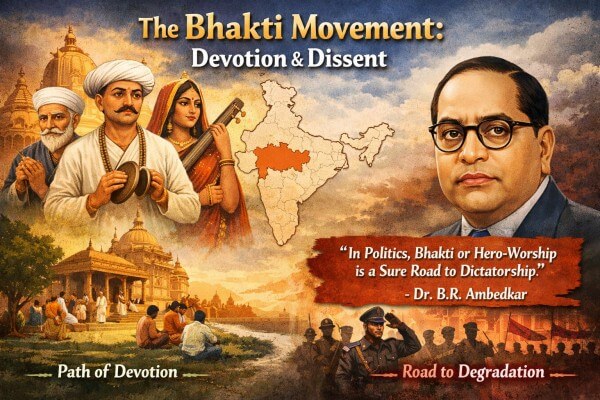
We will discuss emergence of Bhakti movement, its importance and influence in Maharashtra and other parts of the country. For in India, Bhakti or what may be called the path of devotion or hero-worship, plays a part in its politics unequalled in magnitude by the part it plays in the politics of any other country in the world. Bhakti in religion may be a road to the salvation of the soul. But in politics, Bhakti or hero-worship is a sure road to degradation and to eventual dictatorship. (Dr. B.R. Ambedkar. Speech to the Constituent Assembly on 25 November 1949.)
The Bhakti movement originated in south India in the 6thcentury and then gradually spread to Karnataka, Maharashtra and further to the northern parts of India. Though the movement reached its peak in the 15thand 16thcenturies, it continued to flourish till the late 18thcentury in different forms. Spread over almost the whole of India, the movement advanced with the emergence of several notable saints, many of them from low castes, such as the following:
- Kabir (1440-1518)
- Ravidas (15th century)
- Dadu (1554-1603)
- Eknath (1533-1599)
- Nanak (1469-1539)
- Tukaram (1608-1649)
- Janabai
- Namdev (1270-1350)
- Akka Mahadevi (1130-1160)
- Chokhamela (14th century)
- Savata Mali
Maharashtra underwent cultural metamorphosis during the 12th and the 13th centuries. During this period, various religious sects such as the following emerged:
- Nathsampradaya founded by Gorakshanath (1050-1150)
- Lingayat sampradaya founded by Shri Chakradhar (1213-1272)
- Varakari sampradaya associated with Sant Namdev (1270-1350) and Dnyandeo (1271-1309)
Historical Background
Let us understand the historical context of the Bhakti movement. The Bhakti tradition was spearheaded by a few poets, who later came to be known as sants. The Bhakti tradition in medieval India was a cultural-religious movement led by poets who were called saints. A remarkable feature of this movement is that these saint-poets emerged from the lower layers of the caste hierarchy. Being low caste artisans and laborers, they knew well the social agonies of this section of society and being poets, they could express well these agonies in the form of complaints, rage, devotion and so on. These medieval saint-poets have remained torchbearers for the masses across India today.
Many of these devotional cults were, as Vijaya Ramaswamy argues, heterodox and reflective of an inner social ferment. The Bhakti movement, by and large, rejected the existing ritual hierarchy and Brahmanical superiority. However, the response to the Bhakti movement is ambivalent because some see it as devotionalism whereas others see it as the rise of the low-caste devotees and poets against the authoritative Brahmanical religion.
In Maharashtra, the Bhakti tradition was immediately preceded by the rule of the Yadav dynasty. When the Bhakti movement was in the offing, Ramdevrao Yadav was ruling Maharashtra, and the Yadav dynasty had been in deep crisis and was bound to fall. Ramdevrao and his prime minister Hemadri were completely engrossed in Brahmanical rituals. When Allahauddin Khilji attacked his kingdom, he gave it up easily.
During this period, two spiritual movements emerged in Maharashtra:
- Mahanubhav
- Varkari
The Mahanubhav sect, founded by Chakradhar Swami (1132-1169), who is said to have come from Gujarat, was partly influenced by the Vedic as well as Jain / Buddhist ideologies.
Both the Mahanubhav and the Varkari sects used people’s languages for communicating their ideas.
Recently, some scholars have begun to analyze the Bhakti tradition in the context of Buddhist history and argue that though the Bhakti tradition was partly entrenched in Vedic devotionalism, it was also influenced by Buddhism. Quite often, Buddhism and Bhakti movements are seen as protest movements against Brahmanism.
There are many problems in studying the saint-poets’ writings in general and low-caste saint poets’ writings in particular. Some of them are:
- Authentic and critically edited versions of the writings of these poets are not available. For example, the writings of poets such as Chokhamela, Kabir, Tukaram have been either partly destroyed or interpolated.
- The existing records of the Bhakti tradition, which came from the 13th to the 18th centuries, by and large came through the Brahmins and reflect their viewpoints.
- No authentic and contemporary biographical information of the poets is available. For example, the biography of Nandnar, a Tamil saint-poet who lived during 660-842 CE period, was written 400 years after his death (i.e., in the 12th century).
- Ideologically, there are many versions of the same saint-poets.
The movement needs to be studied in the context of the material available and the reality of the times. The movement arose when the Indian society had forgotten the rich heritage of Buddhism. By the time the early proponents of Bhakti began to emerge, the society had already turned feudal. Feudal ruling groups had begun to appropriate the surplus produced by the peasantry and the artisan castes. The general picture of the society was that of chaos. The economic conditions and poverty were further worsened by the tightening grip of Brahmanical ritualism. The scenario was made more complex by the following:
- Large number of gods
- Large number of castes
- Growing influence of patriarchy and the notion of purity
- Increasing feudalization of land relationships
Significance of the Bhakti Tradition
The Bhakti tradition has had a profound impact on Marathi people and shaped their ‘world-image’. M G Ranade, one of the social reformers from Maharashtra, believed that the Varkari sect and its socio-cultural practices created conditions conducive to the formation of the political state of Shivaji:
It was not the work of one man, or of a succession of a gifted man. The foundation was laid broad and deep in the hearts of the whole people and unlike the subhedarships of Bengal, Karnatik, Oudh and Hyderabad, the rise of the ‘Maratha Power’ was due to the first beginnings of what one may well call the process of nation-making….It was the upheaval of the whole population, strongly bound together by the common affinity of language, race, religion and literature and seeking further solidarity by a common independent political existence.
The Bhakti tradition influenced virtually every socio-cultural movement in the 19th and 20th centuries. Many socio-cultural organizations such as Prarthana Samaj of the 19th century and many social reformers such as Gadge Baba of the 20th century were influenced by the Varkari sect. The Satyashodhak movement, the most radical movement of the 19th century Maharashtra, was also deeply influenced by the underlying anti-caste radical potential inherent in the Varkari sect. While being critical of the brahmanical nature of the Bhakti tradition, Jotirao Phule (1927-90) could not escape his affinity for saintpoets like Tukaram. Many of his allies in the movement like Gyanoba Sasane and Mukundrao Patil were also influenced by the Varkari sect.
Views on Religion
Many subaltern scholars have been engaged in discovering similarities between the bygone Buddhist tradition and the medieval Bhakti tradition. They argue that Bhakti was profoundly influenced by the Buddhist philosophy. However, there are few differences between the two in terms of form and degree. These scholars have pointed out that both were relatively anti-establishment. The proponents of the Bhakti movement opposed religion that was imbued with ritualism, orthodoxy and exploitative cultural ethos. Instead, they looked at religion as a power that could be used for raising a voice against oppression. This was an attempt to respond to the upper castes that had used religion as a tool to establish their own dominance.
Though the Bhakti movement was focused on the spiritual idea of worship, it was also imbued with humanism and universal brotherhood. The proponents of the Bhakti movement were trying to displace the old religion, which was lost in external pomp and caste dogmatism, and replace it with a broad minded and compassionate religion. Many medieval saint-poets did not denounce material life and seek an escape into spirituality. They thought religion was necessary for establishing social justice. Since there was no possibility of providing an alternative to the exploitative material order of society, the saint poets were left with no option but to look for equality in the dominion of culture and society.
The poets came from the lower rungs of society, and their notion of God was different from the orthodox understanding of God as omnipotent, omniscient and omnipresent. In fact, these poets paid greater attention to the devotees than to God. They refused to accept God as representing the supreme authority. For these poets, God was just one of them. Many of these poets talked to God in their poetry and, at times, rebuked God for not helping them in crises. For example, Janabai and Tukaram quarrel with Vitthal for not sharing life with them as real friends do.
The Guru-Shishya Tradition in the Bhakti Movement
Now we will discuss the role of Guru-Shishya tradition. In the hegemonic scriptural religion, unlimited authority was wielded in the institutionalized position of guru, the mentor. Ancient scriptures such as Manusmruti and medieval texts such as Gurucharitra and Dasbodh deemed only the Brahmans as eligible for the elevated position of the guru. These texts mention that a non-Brahman, irrespective of her or his scholarship or spiritual attainments, was not eligible to be a guru. This is the reason why in the Hindu sects the ‘gurus’ are treated with great honor and reverence.
However, in the Bhakti cult, lowly born poets were also venerated as gurus by the high-born disciples. This attempt of reversing the logic of guru-shishya tradition in the Bhakti movement was heavily criticized by priestly classes. Those who revered the lowly born poets as their gurus were at times criticized and punished. The Brahmanical classes came down upon this phenomenon very heavily. For example, Bahinabai (1628-1700), a saintpoet born in a Brahman family, accepted Tukaram as her guru and Mirabai, a saint-poet born in a Rajput family, accepted Ravidas as her guru. In Maharashtra, Samartha Ramadasa dismissed the idea of lower-caste guru:
In becoming low-caste guru is lost morality
Who will ask the Brahmin mastered the Vedas
The Bhakti movement contested the traditional Brahmanical notion of guru. As discussed earlier, the Brahmanical notion of guru conformed Brahman as a sole guru for all. However, in the Bhakti movement, the saint-poets refused to follow the archetypal dichotomy in the relationship between Brahman guru and non-Brahman disciple. There are many instances of such defiance.
The Bhakti Movement and Synchronic Tradition
Many scholars have argued that the Bhakti movement in India played a significant role in lessening religious orthodoxy and synchronizing the Hindu and the Muslim faith systems. They tried to harmonize the orthogenetic and heterogenetic elements of the great and little traditions of Hinduism and Islam. These saints professed the values and principles not from the hegemonic scriptures; however, they preached a philosophy of life that was closer to the lives of the common people among both Hindus and Muslims.
Maharasthra had around 42 Muslim saint-poet. There was a healthy dialogue between the Hindu saint poets and Muslim saint-poets. For example, Janardan pant, the guru of Enkath, was a disciple of Chand Bodhale. There was a Muslim saint-poet named Shaikh Mohammad in Shrigonda in Ahmednagar district. The Muslim poets showed tremendous interest in the Bhakti cults such as Chaitanya, Nath, Varkari and Datta. A peculiar confluence between the Hindu and the Muslim traditions is seen in Sufism.
Bhakti Tradition and Language
The issue of languages is complex in India. The complexity involved in the linguistic scenario in India is a corollary to the varna-caste order. Multilingualism in India is an outcome of the complex and fragmented system of varna-caste order in India. One of the essential pre-conditions for the maintenance of varna-caste order was the lack of uniform mode of communication and scriptural injunctions against learning certain languages such as Sanskrit.
Rise of Sanskrit as a language of the priestly class was a peculiar phenomenon appropriate for the development of the varna order. Access to Sanskrit was limited to the priestly class and this facilitated their hegemony in knowledge. The lower castes were forced to use the language that was stigmatized as unsuitable for any philosophical discourse.
People’s languages developed during the Buddhist period and were used as the languages of knowledge and philosophical discourse. The Buddha insisted on using people’s languages while delivering discourses. As a result, a lot of literature in the form of writings, stories, songs and fables emerged in these languages.
Keeping in tune with the linguistic practice of Buddhists, the saint-poets preferred to use the languages of the populace for delivering their messages. They had to fight with the priestly castes to establish their claim on these languages for religious and philosophical discourses. For example, Saint Eknath had this to say in favor of Prakrit:
If Sanksrit had come from God
Did Prakrit come from the thieves?
Moreover, these poets also had to develop these languages to the extent that they could be used for poetry and philosophy. The saint-poets’ decision to select the Prakrit languages was to ensure large scale participation of peasantry, artisans and other ritually inferior but economically powerful groups in these devotional movements.
Dilip P. Chitre argues that medieval Marathi poetry developed in two divergent directions. One continued from the Sanskrit classics – both religious and secular. These classicists neglected or excluded the use of the native colloquial Marathi. However, only a minority of writers have produced such ‘classicist’ literature.
The other tradition continued from the Prakrit languages. Early saint poets such as Dnyaneshwar and Namdeo had to win over linguistic orthodoxy in order to claim that Marathi was equally eligible for the use of poetry.
Women Saint-Poets
The emergence of women-saint poets was an important phenomenon in the medieval period. Vijaya Ramaswamy argues that the morphology of feminine spirituality in India lies in the long record of male oppression and sexual exploitation which characterized the condition of women in traditional India. Indian society being essentially patriarchal, the position of women was markedly inferior.
Vijaya Ramaswamy further argues that the life and works of the women saints are shrouded in mystery unlike those of the men saints. This was partly because none of them established a guru paramparã or monastic tradition with disciples who might have preserved the sayings or compositions of the saints. The one exception seems to have been Venabai, the disciple of Samartha Ramadasa (17th century) who became the head of the math at Miraj.
In Maharashtra, there were a few women-saint poets. Some of the prominent women saints were:
- Muktabai (Dnyaneshwar’s sister),
- Bahinabai (wife of Kulkarni),
- Rajai (daughter of Namdeo),
- Soyarabai (Chokhabai’s wife).
The struggle of Bahinabai epitomises the struggle of a woman poet to establish her right to expression. In her poetry, she challenges caste, patriarchy and religion. She registers a complaint against her husband for beating her. Bahinabai translated the anti-varna text Vajrasuchi, which was written by a Buddhist scholar Ashvaghosh.
Janabai was another saint-poet. Born in a poor low-caste family, Janabai expressed rebellious thoughts in her poems. She had bitter experiences of being a Shudra and also a woman. She refused to succumb to the Brahmanical and patriarchal dominance and continued to express her contempt for the dominant order.
Ambedkar on Bhakti Movement
B. R. Ambedkar did not have any ambivalence on the medieval Bhakti movement. The clarity of his position on this movement emerged from his scientific and unprejudiced outlook on history. Neither did he dismiss the Bhakti movement as an empty and fruitless effort, nor did he eulogize the Bhakti movement as liberatory.
He used this as a litmus test to assess the Bhakti movement. Using this criterion, he found that the saint-poets in Maharashtra revolted against the Chaturavrya or varna order in the society. They tried to establish the superiority of the devotee over the Brahman; however, they did not try to establish superiority of human beings over the Brahman. He further argues that the value of human beings cannot be established in terms of Bhakti as the value of human beings is self-evident. Though he argues that the Bhakti movement was a revolt against Brahmanism, it did not succeed in challenging the innate superiority of the Brahmans.
However, Ambedkar pointed out the progressive nature of the Mahanubhav sect in the medieval period. He argues that the Mahanubhav sect was against caste and was free from the notion of touch-untouch and orthodoxy. He also admired Tukaram and used his poetry frequently in his periodicals and writings. He compared Tukaram with the Buddha and argued that Tukaram’s views on non-violence were close to those of the Buddha. He also expressed his desire to use Pali literature to prove that Pandharpur was originally a Buddhist site.


